
Glass Manufacturing Company in India: How Safety Glass Is Made, Tested and Supplied
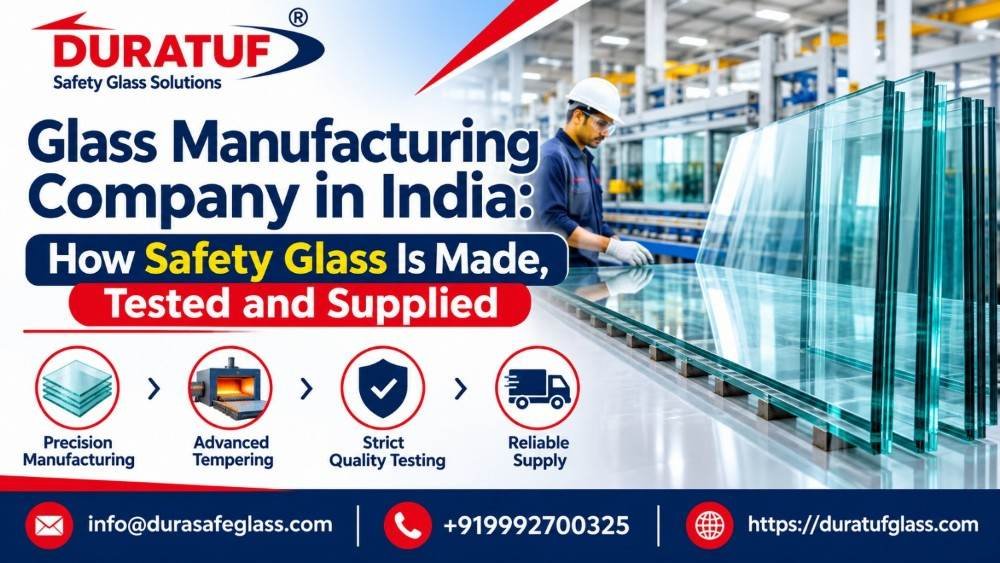
A glass manufacturing company in India turns raw glass into products that are safe, accurate and ready to install. Some companies run float lines that melt sand and soda ash into flat sheets. Others, including many safety glass specialists, take those sheets and process them into toughened, laminated and insulating glass for specific jobs. Both types matter, and knowing the difference helps you ask better questions.
What does a glass manufacturing company in India do?
It covers one or more stages of the glass chain: melting, forming, cutting, shaping, strengthening, bonding, sealing, testing and delivery. A buyer of bus windscreens cares about the final three stages. A builder ordering facades cares about thermal performance and panel size. The best glass manufacturing company in India for your project is the one whose strengths match your use.
From sand to sheet: the float process
Float glass starts with silica sand, soda ash, limestone and recycled glass called cullet. These are melted at very high temperatures, then poured onto a bath of molten tin so the ribbon spreads out flat and smooth. It is slowly cooled, inspected and cut into large sheets. The float glass method on Wikipedia explains the steps in more detail.
From sheet to safety glass: the processing stages
| Stage | What happens | Quality check |
| Cutting | Large sheets are cut to drawing size | Dimensional accuracy |
| Edgework | Edges are ground and polished | Visual and chip inspection |
| Drilling and notching | Holes and cut-outs are made | Position tolerance |
| Washing | Surface is cleaned | Contamination check |
| Toughening | Heated and rapidly cooled | Fragmentation and flatness |
| Laminating | Interlayer bonded between panes in an autoclave | Bond and clarity check |
| Insulating assembly | Panes joined with a sealed spacer | Seal and moisture check |
| Packing and dispatch | Crated and labelled | Final audit |
How laminated glass is made
Two panes of glass are cleaned, then a tough plastic interlayer such as PVB is placed between them. The sandwich goes through heat and pressure in an autoclave, which bonds everything into one clear unit. If it cracks, the pieces stay attached. This is why a laminated windshield for buses is the standard safety choice for front glazing, and why laminated glass is also used overhead in buildings.
Why quality control separates good from average
Every stage can introduce a defect. Poor washing leaves marks, uneven heating causes distortion and weak edges lead to later breakage. A serious glass manufacturing company in India will inspect at each stage, not only at the end, and keep records you can ask to see. A management system certified to ISO 9001 shows that processes are documented and audited. For national safety requirements, refer to the Bureau of Indian Standards.
Who buys from a glass manufacturing company in India?
- Bus, truck and car makers who need windscreens and side windows.
- Railways and off-highway equipment builders.
- Builders and facade contractors.
- White goods and cookware brands.
- Security-sensitive users who need bullet-resistant glass.
How to evaluate a glass manufacturing company in India
- Visit or request plant details. Check machinery, cleanliness and handling.
- Ask for test records. Look for batch traceability.
- Check range. A supplier with toughened glass, laminated glass and insulating units can often advise more objectively.
- Review customers. Long-term clients in demanding sectors are a good sign.
- Test communication. Quick, clear technical replies usually predict smooth delivery.
About Duratuf Glass
Founded in 1986 by Mr N.C. Gupta, Duratuf Glass focuses on safety glass for buses, trains, earthmoving equipment and architecture. It operates from locations in Haryana, Delhi, Madhya Pradesh and Karnataka, which supports regional supply. If you want a specific product discussed, contact Duratuf Glass with your requirement.
For wider context on how glass is classified and used, the Britannica glass article is a reliable read.
Frequently asked questions
- What is a glass manufacturing company in India?
A business that produces or processes glass into finished products for vehicles, buildings and industry.
- Do all glass manufacturers make float glass?
No. Float lines are large facilities. Many specialists buy float glass and process it into safety products.
- What raw materials go into glass?
Mainly silica sand, soda ash, limestone and recycled glass.
- How is toughened glass different from laminated glass?
Toughened glass is strengthened by heat and rapid cooling. Laminated glass bonds two or more panes with an interlayer so it stays together when cracked.
- What is an autoclave used for?
It applies heat and pressure to bond laminated glass layers into one clear unit.
- How can I tell if a glass manufacturer is trustworthy?
Check certifications, test records, plant details, client references and responsiveness.
- Can glass be customised for my project?
Yes. Size, thickness, shape, holes, edges, tint and interlayer can usually be specified.
- Why is quality control important in glass making?
Small flaws in glass can cause breakage later, so inspection at each stage protects safety.
- Does a glass manufacturing company in India export?
Many do, subject to standards and logistics. Ask the supplier about export experience for your destination.
- How do I get technical advice before ordering?
Share your drawings and application with the team through the contact page.
Next step
List your application, quantity and drawings and ask for a technical recommendation before you finalise glass types.