Commercial Vehicle Window Glass Manufacturers in India: Safety Standards, Types & Solutions
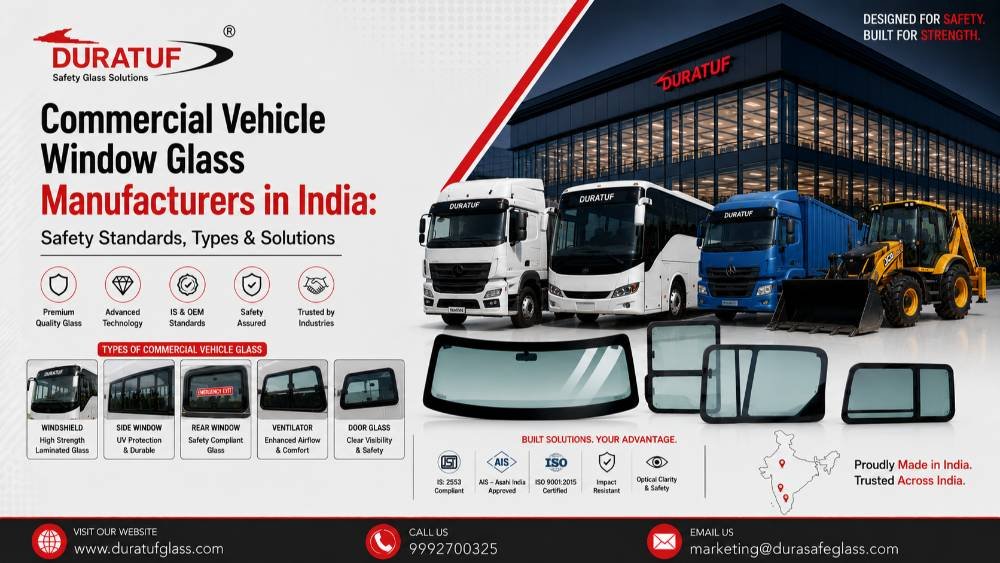
India’s commercial vehicle industry forms the backbone of the nation’s economy. From buses carrying millions of passengers daily to trucks transporting goods across the country, commercial vehicles keep India moving. At the heart of every bus, truck, and heavy vehicle lies a critical safety component that often goes unnoticed—the window glass.
Commercial vehicle window glass is fundamentally different from passenger car glass. It must withstand greater vibrations, more extreme temperature variations, higher impacts from road debris, and longer operational hours. For fleet operators, bus body builders, and truck manufacturers, understanding the landscape of commercial vehicle window glass manufacturers in India is essential for making informed procurement decisions.
This comprehensive guide explores everything you need to know about commercial vehicle glass—from safety standards and glass types to leading manufacturers and selection criteria.
Understanding the Commercial Vehicle Glass Market in India
The Indian automotive glass market is experiencing robust growth. According to the IMARC Group , the market was valued at USD 948.73 Million in 2025 and is projected to reach USD 1,433.66 Million by 2034, growing at a compound annual growth rate of 4.30% . The market is driven by surging domestic vehicle production, mandatory safety regulations promoting laminated glass adoption, and rising consumer preference for thermally efficient and acoustically superior glazing solutions.
The India Brand Equity Foundation (IBEF) reports that the Indian automobile industry manufactured 3.10 crore units of vehicles in FY25. The auto component industry generated a turnover of US$ 78.7 billion (Rs. 6.73 lakh crore) in FY25, demonstrating a 14% compound annual growth rate in recent years.
According to industry reports, India produced significant volumes of commercial vehicles during 2025, with the automobile sector contributing nearly 15% of the country’s GST Revenue Collections and providing an estimated 30 million jobs across the entire automotive value chain.
North India leads all regions with a substantial market share in automotive glass, driven by concentrated automotive manufacturing hubs in Haryana, established OEM supply chains, and strong vehicle assembly presence.
The Commercial Vehicle Glass Opportunity
The heavy commercial vehicle windows and exterior sealing market in India has shown impressive growth. ICRA expects the domestic commercial vehicle industry’s wholesale volumes to witness steady growth in the coming years. This growth is further supported by regulatory changes, including the mandatory installation of air-conditioned cabins for trucks from October 2025 onwards.
As automotive glass suppliers in Haryana continue to expand their manufacturing capacities, the commercial vehicle glass segment presents significant opportunities for both OEMs and aftermarket suppliers.
Types of Commercial Vehicle Window Glass
Commercial vehicle windows come in several types, each designed for specific applications and safety requirements.
| Glass Type | Description | Primary Applications | Key Characteristics |
| Laminated Glass | Two glass layers bonded with a PVB (polyvinyl butyral) interlayer | Windshields for buses, trucks, and heavy equipment | Cracks but stays bonded on impact; prevents occupant ejection; provides UV protection |
| Toughened/Tempered Glass | Heat-treated glass that is 4-5 times stronger than ordinary glass | Side windows, rear windows, cabin glass | Breaks into small, blunt pieces; highly impact-resistant; scratch-resistant |
| Bulletproof/Ballistic Glass | Multi-layer composite of glass and polycarbonate | Armored vehicles, VIP transport, security applications | Resists ballistic impacts; multiple protection levels available |
| Acoustic Glass | Laminated glass with acoustic PVB interlayer | Premium buses, luxury coaches | Reduces noise penetration; improves cabin comfort |
| Solar Control Glass | Coated glass that reduces heat and UV radiation | All vehicle types, especially in hot climates | Lowers cabin temperature; protects occupants from UV rays |
Laminated Glass for Windshields
Laminated glass is the standard for commercial vehicle windshields. It consists of two glass layers bonded together with a PVB interlayer. When impacted, the glass cracks but the PVB layer holds the pieces together, preventing them from entering the cabin. This is particularly critical for bus and truck drivers who need protection from flying debris.
DURATUF’s laminated windshields for buses are manufactured to the highest safety standards, with the company producing glasses in large dimensions suitable for various bus models.
Toughened Glass for Side Windows
Toughened (tempered) glass is heat-treated to be four to five times stronger than ordinary glass. When it breaks, it shatters into small, blunt granules rather than sharp shards, reducing the risk of injury. DURATUF’s side window glass for buses is toughened to handle constant vibration, repeated opening and closing, and exposure to sun and rain.
Aluminium Window Frames
For bus body builders, pre-assembled units offer significant advantages. DURATUF’s aluminium window frames for buses come with glass already fitted inside the frame at the factory. This eliminates the need for on-site cutting, sealing, and adjustment, saving time and ensuring consistent quality.
Safety Standards for Commercial Vehicle Glass in India
Commercial vehicle window glass must comply with stringent safety standards to ensure occupant protection.
IS 2553: The Primary Standard
The Bureau of Indian Standards (BIS) has established IS 2553 as the primary standard for safety glass used in motor vehicles. The standard is divided into two parts:
- IS 2553 (Part 1):2018 classifies safety glass into two types: Toughened (Tempered) and Laminated Safety Glass
- IS 2553 (Part 2):2019 specifies requirements for safety glass used in road transport
The Bureau of Indian Standards (BIS) oversees the certification and compliance of safety glass in India.
AIS Standards
In addition to BIS certification, automotive glass must comply with Automotive Industry Standards (AIS) issued by the Ministry of Road Transport and Highways. The AIS-037 standard specifically addresses safety glass requirements for automobiles.
Certification Requirements
All vehicles and auto parts subject to the Central Motor Vehicles Rules (CMVR) must apply for certification with accredited certification bodies like ARAI (Automotive Research Association of India) or ICAT. Components must undergo:
- Technical standards review
- Component testing
- Production consistency audits
Why Standards Matter
For industrial vehicle glass solutions India, compliance with these standards is non-negotiable. Non-compliant glass can:
- Fail to protect occupants during accidents
- Shatter dangerously upon impact
- Provide inadequate visibility in adverse conditions
- Result in legal liabilities for manufacturers and fleet operators
Leading Commercial Vehicle Window Glass Manufacturers in India
DURATUF Glass Industries
DURATUF Glass Industries is one of India’s leading flat and curved glass producers, established in 1986 at Bahadurgarh, Haryana. The company supplies glass and glazing products for buses and light commercial vehicles both in India and abroad under the brand names DURATUF and DURASAFE.
Learn more about DURATUF’s journey and how the company has established itself as a leading innovator in the glass industry, specializing in Laminated Glass, Toughened Glass, Bullet-Resistant Glass, Architectural Glass, Insulating Glass, Glass Cookware Lids, and Aluminium Windows for buses, trains, and other earthmover equipment.
Key Highlights:
- Founded in 1986 at Bahadurgarh, Haryana
- Conglomerate of multiple manufacturing units located in Haryana, Delhi, and Bangalore
- Products exported to Bangladesh, Sri Lanka, and Nepal
- Produces glasses in large dimensions suitable for various vehicle types
OEM Customers:
DURATUF’s glasses are trusted by leading vehicle OEMs including Ashok Leyland, Tata Motors, Volvo, SML Isuzu, Eicher, Mahindra & Mahindra, Scania, Bharat Benz, and HM, as well as bus body builders like ACGL, JCBL, Azad Coach, Irizar TVS, and Sutlej. In the State Transport Undertaking (STU) segment, the company caters to KSRTC, MSRTC, TNSTC, APSRTC, RSRTC, Haryana Roadways, and others.
Product Range:
- Side window glass for buses – toughened glass for constant vibration and daily wear
- Laminated windshields for buses – two glass layers bonded with a PVB interlayer
- Aluminium window frames for buses – pre-assembled units with glass already fitted
- Automotive glass for cars – comprehensive range for passenger vehicles
- Glasses for backhoe loaders – specialized glass for construction equipment
- Bullet proof glass for armored vehicles – ballistic protection for security applications
Explore DURATUF’s comprehensive solutions across automotive, earth movers, bulletproof, railway, white goods, architecture, and cookware segments. Contact DURATUF for inquiries about their comprehensive range of commercial vehicle glass solutions.
Asahi India Glass Limited (AIS)
Asahi India Glass Limited (AIS) , headquartered in Gurugram, Haryana, is India’s leading integrated glass solutions company. Founded in 1984, AIS has established itself as the dominant player in the automotive glass segment.
Key Highlights:
- Headquarters in Gurugram, Haryana
- Strong leadership across commercial, off-highway, and rail categories
- Multiple manufacturing/sub-assembly units across India
- Manufacturing plants at Bawal (Haryana), Roorkee (Uttarakhand), Chennai (Tamil Nadu), and Taloja (Maharashtra)
Innovations:
According to industry reports, AIS is evolving from being a glass supplier into a design partner, supporting several customers with auto glass design and development. The company is developing advanced, certified bullet-resistant glass for defence OEMs such as Tata Motors and Mahindra & Mahindra. It has also introduced smart glazing solutions including illuminated laminated sunroofs, laminated side-lites, and AR-HUD-ready windscreens.
Other Notable Manufacturers
- Saint-Gobain Sekurit India – Specializes in laminated automotive glass for vehicle windshields
- Guardian Industries – Manufactures laminated windshields, tempered sidelites and backlites, and panoramic sunroof assemblies
Heavy Vehicle Windows India: Solutions by Vehicle Type
Bus Windows
Buses require large, durable windows that can withstand daily passenger use and road vibrations.
Windshields: Bus windshields are significantly larger than car windshields and use laminated glass for safety. DURATUF’s laminated windshields for buses are manufactured to the highest safety standards.
Side Windows: Side windows use toughened glass that breaks into small, blunt pieces upon impact. DURATUF’s side window glass for buses is designed for constant vibration and daily wear.
Window Frames: Aluminium window frames with pre-fitted glass offer a complete solution for bus body builders. DURATUF’s aluminium window frames for buses eliminate on-site fitting challenges.
Truck Windows
Trucks operate in demanding conditions, requiring glass that can withstand long hours on the road, constant vibration, and exposure to extreme weather.
Windshields: Truck windshields use laminated glass for safety and durability.
Side Windows: Side windows use toughened glass that can withstand the rigours of daily operation.
Mining and Construction Equipment
Mining and construction equipment operate in some of the harshest environments. DURATUF’s solutions page showcases specialized glass for earthmover equipment:
- Glasses for backhoe loaders – toughened glass for construction equipment
- Glasses for combine cabins – glass for agricultural machinery
- Glasses for tractor cabins – durable glass for tractors
- Glass for hydra cabins – specialized glass for hydra equipment
Bulletproof Automotive Glass India: Security Solutions
The demand for bulletproof automotive glass India has grown significantly with increasing security concerns. Bulletproof (ballistic) glass is a multi-layered composite of glass and polycarbonate designed to absorb and stop the energy of a bullet or projectile.
Protection Levels
| Protection Level | Typical Threat Stopped | Common Application |
| Level 1 / B1 | 9mm pistol | Guard posts, factory gates |
| Level 2 / B2 | .357 Magnum | Bank counters, sentry cabins |
| Level 3 / B3 | .44 Magnum | Security vehicles |
| Level 4 / B4 | Rifle rounds (5.56 NATO) | Armored vehicles |
| Level 6 / B6 | AK-47, 7.62mm rifle | VIP transport, defense vehicles |
Bulletproof Glass Manufacturers
DURATUF manufactures bullet proof glass for armored vehicles with multi-layer glass and polycarbonate composite construction. The company’s bulletproof glass products cater to both domestic and international markets, with panel types including windshields, side windows, rear windows, gun ports, and bus-scale panels.
AIS is developing advanced, certified bullet-resistant glass to meet the localization needs of defence OEMs such as Tata Motors and Mahindra & Mahindra.
Applications
Bulletproof automotive glass is used in:
- VIP and VVIP vehicles
- Armoured transport vehicles
- Military and paramilitary vehicles
- High-security civilian vehicles
- Sentry booths and security enclosures
Why Choose Haryana-Based Commercial Vehicle Glass Manufacturers?
Haryana has emerged as the preferred location for commercial vehicle glass manufacturing. Here’s why:
Strategic Location
Haryana’s proximity to Delhi NCR, major highways, and industrial corridors makes it an ideal location for automotive glass manufacturing. Suppliers can efficiently serve clients across North India and beyond.
Manufacturing Excellence
The region boasts state-of-the-art manufacturing facilities. AIS operates a plant at Bawal, Haryana, with substantial production capacity. DURATUF operates multiple manufacturing units across Haryana, Delhi, and Bangalore.
Quality Standards
Haryana-based suppliers adhere to stringent quality standards, complying with ISI certification as per the Bureau of Indian Standards (BIS) guidelines for IS 2553 (Part 2):2019 .
Industry Experience
With decades of experience, Haryana-based suppliers have developed deep industry expertise:
- DURATUF established in 1986
- AIS established in 1984
Proximity to OEMs
Haryana is home to major automotive manufacturing plants, including Maruti Suzuki’s facilities in Manesar and Gurugram, making it logistically efficient for glass suppliers.
Future Trends in Commercial Vehicle Glass
1. ADAS Integration
Advanced Driver Assistance Systems require specialized windshields with ADAS mounting brackets integrated into the glass.
2. Smart Glass Technology
The integration of smart glass technologies is transforming the commercial vehicle industry, including switchable glass for privacy and comfort, and solar control glass for temperature management.
3. Sustainability Focus
Environmental concerns are driving innovation in eco-friendly manufacturing processes, recyclable glass materials, and energy-efficient production methods.
4. Air-Conditioned Cabins
The mandatory installation of air-conditioned cabins for trucks from October 2025 is expected to drive demand for specialized glass solutions that support climate control systems.
5. Capacity Expansion
Leading suppliers are expanding their manufacturing capabilities to meet growing demand.
How to Choose the Right Commercial Vehicle Glass Manufacturer
For OEM Requirements
- Quality Certification: Ensure the supplier meets international quality standards and BIS certification as per IS 2553
- Production Capacity: Verify the supplier can meet your volume requirements
- Technology Capability: Assess their ability to produce advanced glass solutions
- Supply Chain Reliability: Evaluate their delivery track record
- Value Proposition: Compare offerings while maintaining quality standards
For Fleet Operators
- Durability: Ensure glass can withstand heavy-duty operations
- Safety Standards: Verify compliance with commercial vehicle safety regulations
- Bulk Supply Capability: Confirm ability to handle fleet requirements
- Service Support: Evaluate after-sales support and maintenance services
- Warranty: Check for comprehensive warranty coverage
For Mining and Construction Equipment
- Impact Resistance: Ensure glass can withstand flying debris
- Temperature Tolerance: Verify glass can handle extreme conditions
- Customization Options: Assess ability to meet specific equipment requirements
- Ballistic Certification: For security applications, verify ballistic standards compliance
- Track Record: Research experience in mining and construction equipment glass
Frequently Asked Questions (FAQs)
1. What are the main types of commercial vehicle window glass?
Commercial vehicle window glass comes in two main types: laminated glass (used for windshields) and toughened/tempered glass (used for side windows and rear windows). Laminated glass consists of two glass layers bonded with a PVB interlayer, while toughened glass is heat-treated to be stronger and break into small, blunt pieces.
2. Which are the leading commercial vehicle window glass manufacturers in India?
The leading manufacturers include DURATUF Glass Industries (established in 1986, with multiple manufacturing units across India) and Asahi India Glass Limited (AIS) (headquartered in Gurugram, Haryana).
3. What safety standards apply to commercial vehicle glass in India?
Commercial vehicle glass must comply with IS 2553 (Part 1):2018 for toughened and laminated safety glass and IS 2553 (Part 2):2019 for safety glass used in road transport. Additionally, components must comply with AIS-037 standards.
4. Why is Haryana preferred for automotive glass manufacturing?
Haryana offers strategic advantages including proximity to Delhi NCR, excellent connectivity, robust industrial infrastructure, and proximity to major automotive OEMs. North India leads the automotive glass market with a significant share, driven by concentrated automotive manufacturing hubs.
5. What is bulletproof automotive glass, and who supplies it in India?
Bulletproof automotive glass India refers to multi-layered glass and polycarbonate composites designed to resist ballistic impacts. Leading suppliers include DURATUF , which manufactures bullet proof glass for armored vehicles with multi-layer glass and polycarbonate composite construction.
6. What glass solutions are available for buses and trucks?
For buses and trucks, manufacturers offer laminated windshields for buses, side window glass for buses, and aluminium window frames for buses.
7. What is the difference between laminated and toughened glass?
Laminated glass is made from two glass layers bonded with a PVB interlayer. It cracks on impact but stays bonded together, making it ideal for windshields. Toughened glass is heat-treated to be stronger and breaks into small, blunt pieces rather than sharp shards, making it suitable for side windows.
8. Can commercial vehicle glass be repaired, or does it always need replacement?
Minor chips and cracks can often be repaired, but severe damage typically requires full replacement. Professional assessment is recommended to determine the best course of action.
9. What is the market outlook for commercial vehicle glass in India?
The Indian automotive glass market is projected to grow from USD 948.73 Million in 2025 to USD 1,433.66 Million by 2034, at a CAGR of 4.30%. The automobile sector contributes nearly 15% of GST Revenue in India.
10. How is the government supporting the automotive glass industry?
The Indian government has introduced the Production Linked Incentive (PLI) Scheme for Automobiles and Auto Components to boost domestic manufacturing of advanced automotive technology products.
Conclusion
Haryana has firmly established itself as the heart of India’s commercial vehicle glass industry, with major players like DURATUF and AIS leading the way in manufacturing glass for buses, trucks, and heavy equipment. The state’s strategic location, manufacturing excellence, and deep industry expertise make it the preferred choice for commercial vehicle glass requirements across all segments.
Whether you are seeking heavy vehicle windows India for fleet operations, exploring industrial vehicle glass solutions India for mining and construction equipment, or looking for automotive glass suppliers in Haryana for OEM partnerships, the state’s manufacturers offer the quality, reliability, and innovation you need.
As the industry continues to evolve with smart glass technologies, ADAS integration, and sustainability initiatives, Haryana’s commercial vehicle glass suppliers are well-positioned to meet the challenges and opportunities of 2026 and beyond. By choosing established suppliers with proven track records, you can ensure safety, quality, and peace of mind for all your commercial vehicle glass requirements.