Bulletproof Vehicle Glass Manufacturers in India for VIP, Defense & Security Vehicles
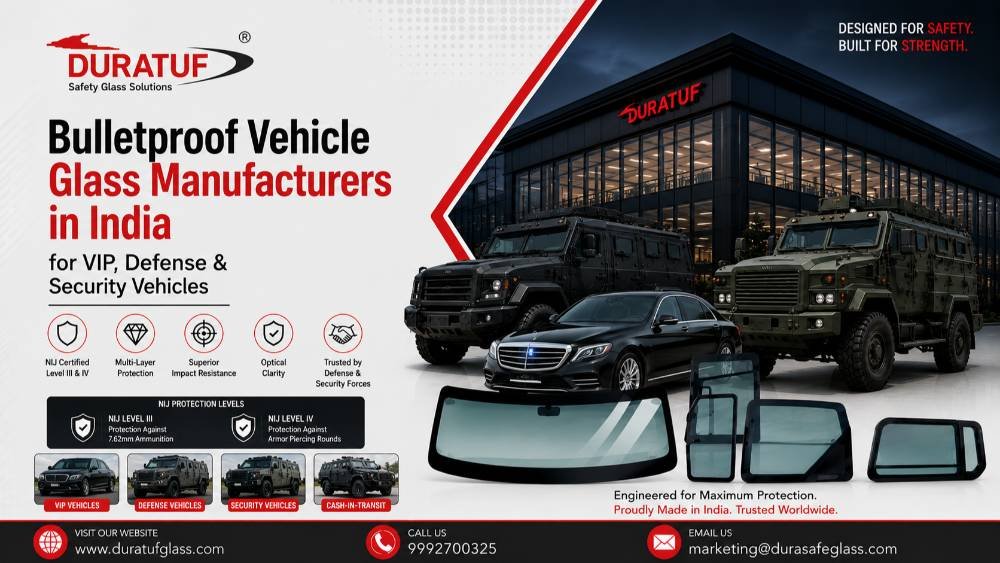
In an era of rising security threats, the demand for bulletproof vehicle glass in India has grown exponentially. From VIP transport and government officials to defense applications and cash-in-transit vehicles, ballistic-resistant glass has become an essential component of modern security infrastructure. This comprehensive guide explores India’s leading bulletproof vehicle glass manufacturers, NIJ protection standards, and specialized solutions for VIP, defense, and security vehicles.
The Growing Bulletproof Glass Market in India
The India bulletproof glass market is experiencing remarkable growth. According to Grand View Research , the market generated revenue of USD 94.4 million in 2024 and is expected to reach USD 193.4 million by 2030, growing at a compound annual growth rate of 13.3%.
As per Coherent Market Insights , the India Bullet Resistant Glass Market is estimated at USD 11.91 billion in 2025 and is expected to exhibit a CAGR of 10.2%, reaching USD 23.51 billion by 2032. The broader India bulletproof glass market is driven by rising demand for innovative security solutions, evolving consumer preferences, and increasing adoption across diverse end-use sectors.
Key Market Drivers
- Rising security concerns across government, corporate, and private sectors
- Increasing VIP and VVIP protection requirements
- Growing defense and military procurement
- Expanding cash-in-transit and security vehicle fleets
- Government initiatives like the Production Linked Incentive (PLI) Scheme for Automobiles and Auto Components
- Increasing implementation of national policies and regulations due to the growing number of attacks at defense, financial, and various private institutions
Asia Pacific Market Context
The Asia Pacific bulletproof glass market is also experiencing strong growth. According to Grand View Research, the region generated revenue of USD 2,313.9 million in 2024 and is expected to grow at a CAGR of 11.4% from 2025 to 2030.
What Is Bulletproof Vehicle Glass?
Bulletproof vehicle glass, also known as ballistic glass or transparent armor, is a multi-layered composite engineered to absorb and stop the energy of bullets and projectiles. It is not a single material but a carefully designed laminate structure combining:
Key Components:
- Laminated glass layers – Provide hardness and optical clarity
- Polycarbonate (Marguard) – Absorbs impact energy and prevents spalling
- PVB (polyvinyl butyral) interlayers – Bond layers together and absorb energy
- Acrylic layers – Additional impact resistance
The combination and thickness of these layers determine the level of ballistic protection. DURATUF manufactures bulletproof glass with thickness ranging from 17mm to 50mm, using polycarbonate (Marguard) from GE Plastics USA. The company’s products are used in light and heavy military vehicles, civil vehicles, armored cars, VIP limousines, and helicopters.
How Bulletproof Glass Works
When a bullet strikes bulletproof glass, the energy is dissipated across multiple layers rather than penetrating through:
- Outer glass layer – Cracks upon impact, absorbing some energy
- PVB interlayer – Stretches and absorbs more energy
- Polycarbonate layer – Stops the bullet or fragments
- Inner glass layers – Provide additional resistance
This multi-stage energy absorption prevents penetration and protects the vehicle’s occupants.
Understanding NIJ Standards for Ballistic Glass
The National Institute of Justice (NIJ) Standard 0108.01 is the most widely recognized benchmark for ballistic resistance in the United States and is used globally for armored vehicles, security booths, and protective materials. The standard applies to all ballistic restraint materials (armor) intended to provide protection against gunfire, with the exception of police body armor and ballistic helmets.
NIJ Protection Levels Explained
The NIJ standard defines five main levels of ballistic resistance, each tested with specific firearms, calibers, and velocities. For automotive applications, Level III and Level IV are the most relevant for high-risk scenarios.
| NIJ Level | Threat Stopped | Typical Application | Key Characteristics |
| Level I | .22 LR, .38 Special | Low-risk protection | Lightweight, basic protection |
| Level II-A | Low Velocity .357 Magnum, 9mm | Basic personal protection | Lightweight, concealable |
| Level II | High Velocity .357 Magnum, 9mm | Standard handgun protection | Greater protection than II-A |
| Level III-A | .44 Magnum, Submachine Gun 9mm | Civilian armored vehicles | Common for executive protection |
| Level III | 7.62mm NATO Rifle Rounds | Security vehicles facing rifle threats | Stops standard rifle ammunition |
| Level IV | .30-06 Armor Piercing | Military, high-threat applications | Maximum protection level |
NIJ Level III: Protection Against High-Powered Rifles
NIJ Level III is designed to stop 7.62mm NATO (M80) rifle rounds with soft-core projectiles. This level requires considerably thicker and heavier materials, often used in security vehicles facing potential rifle threats.
Common applications:
- Armored vehicles for government officials and VIPs
- Security facilities and checkpoints
- Cash-in-transit vehicles
- High-risk civilian transport
- Military vehicles
NIJ Level IV: The Highest Level of Protection
NIJ Level IV is the highest level defined by the NIJ standard. It is designed to stop .30 caliber armor-piercing (AP) ammunition and other high-penetration projectiles.
Common applications:
- Military installations
- High-risk government buildings
- VIP transport in extreme threat environments
- Head of State protection vehicles
- Defense and paramilitary vehicles
A typical bulletproof glass for NIJ IV protection includes 42mm bulletproof glass with PC sheet. Higher-rated windows, typically Level III or higher under the NIJ standard, are designed to withstand rifle rounds.
Beyond NIJ: Other International Standards
While NIJ is the most recognized standard, other international standards are also used for armored vehicles in India:
- EN 1063 – European standard with levels from BR1 to BR7
- STANAG 4569 – NATO standard for military vehicles with levels 1 to 4
- VPAM BRV – German standard for civil protection
- UL 752 – US standard for architectural applications
Leading Bulletproof Vehicle Glass Manufacturers in India
DURATUF Glass Industries
DURATUF Glass Industries is one of India’s leading flat and curved glass producers, established in 1992 at Bahadurgarh (Haryana), near Delhi. The company supplies glass and glazing products to the automotive, security, bulletproof car, and architectural sectors under the brand names DURATUF and DURASAFE.
Key Highlights:
- Founded in 1992 with roots tracing back to 1986
- Conglomerate of seven manufacturing units located in Delhi, Haryana, Indore, and Bangalore
- Bangalore Safety Glass Works Pvt. Ltd. (BSGW) established in 1996 in Bommasandra Industrial Estate, Bangalore
- Products exported to Bangladesh, Sri Lanka, and Nepal
- Winner of India 5000 Best MSME Awards 2020
Bulletproof Product Range:
- Bullet proof glass for armored vehicles – ballistic protection for light and heavy military vehicles, armored cars, and VIP limousines
- Bulletproof glass for VIP vehicles – specialized protection for high-net-worth individuals and government officials
- Bulletproof sentry glasses – security-grade glass for sentry booths and guard posts
- Bulletproof glass for security enclosures – high-strength glasses for security applications
- Automotive glass for cars – comprehensive range for passenger vehicles
- Laminated windshields for buses – safety glass for commercial vehicles
Technical Excellence:
- Special technical collaboration for developing glass and polycarbonate (Marguard) combinations from GE Plastics USA
- Products designed to reduce explosive potential damage from primary blasts
- Complete process carried out under controlled pressure, vacuum, and temperature
- Thickness range: 17mm to 50mm
OEM Credentials:
DURATUF’s glasses are trusted by leading vehicle OEMs including Ashok Leyland, Tata Motors, Volvo, SML Isuzu, Eicher, M&M, Scania, Bharat Benz and HM as well as bus body builders like ACGL, JCBL, Azad Coach, Irizar TVS, Sutlej, etc.
The product range also includes bullet-proof, high-strength glasses for security enclosures. The company has been achieving impressive growth year on year since inception.
Learn more about DURATUF’s journey and explore their comprehensive solutions across automotive, earth movers, bulletproof, railway, and architectural segments. Contact DURATUF for inquiries about their comprehensive range of bulletproof glass solutions.
Asahi India Glass Limited (AIS)
Asahi India Glass Limited (AIS) is India’s leading integrated glass solutions company, established in 1986. AIS offers bullet resistant glass as part of its comprehensive automotive portfolio, which includes windscreens, sidelites, backlite, sunroof, and bullet resistant glass.
Key Highlights:
- 70%+ market share in the car glass segment in India
- Four state-of-the-art production facilities at Bawal (Haryana), Roorkee (Uttarakhand), Chennai (Tamil Nadu), and Taloja (Maharashtra)
- AIS Windshield Experts – India’s number 1 automotive safety glass repair and replacement network
Saint-Gobain India Pvt. Ltd.
Saint-Gobain India Pvt. Ltd. is a global glass manufacturing leader with a strong presence in India’s security glass segment. The company offers bullet-resistant glass solutions for various applications.
Gujarat Guardian Ltd.
Gujarat Guardian Ltd. is a significant player in the Indian glass market, offering security and ballistic glass solutions.
Jeet & Jeet Glass and Chemicals Pvt. Ltd.
Jeet & Jeet Glass and Chemicals Pvt. Ltd. specializes in transparent armour for military and civil protection. The company provides transparent armour for civil protection for security of heads of state as per latest VPAM BRV standards for various vehicles including Toyotas, Fords, and many other vehicles.
JCBL Armouring Solutions
JCBL Armouring Solutions has announced its entry into India’s luxury car armouring market, offering ballistic protection services for high-end vehicles including Mercedes, Range Rover, and Defender models. The company offers certified ballistic protection for high-end cars without compromising performance or aesthetics.
Bulletproof Glass Solutions for Different Vehicle Types
VIP and VVIP Vehicles
Vehicles for heads of state, government officials, and high-net-worth individuals require the highest levels of protection. These vehicles often feature NIJ Level III or Level IV ballistic glass.
Key examples:
- The Range Rover Sentinel is a high-security, armoured vehicle designed for heads of state, senior officials, and VIP protection duties
- The Audi A8 L Security features thick multi-layer security glass with polycarbonate coating that can withstand direct hits from powerful rounds
- JCBL Armouring Solutions caters to prestigious brands like Mercedes, Range Rover, and Defender, ensuring top-tier ballistic protection without sacrificing luxury or performance
Defense and Military Vehicles
Military vehicles require the highest levels of ballistic protection. DURATUF’s bulletproof glass is used in light and heavy military vehicles. These applications often require compliance with multiple standards including NIJ, STANAG 4569, and EN 1063.
According to industry reports, bulletproof glass for defense applications includes:
- Military and Para Military Forces Vehicles
- Armoured and Mine Protected Vehicles
- 360-degree bulletproof vehicles for Prime Ministers and Chief Ministers
Cash-in-Transit Vehicles
Cash-in-transit vehicles face unique threats from armed robbery attempts. These vehicles typically use NIJ Level III glass to protect against rifle attacks while maintaining reasonable weight and mobility.
Security Vehicles and Sentry Booths
Security vehicles and sentry booths require ballistic protection for guards and security personnel. DURATUF’s bulletproof sentry glasses are specifically designed for these applications.
Armoring Process for Vehicles
1. Threat Assessment
The first step in armoring a vehicle is conducting a thorough threat assessment to determine the required protection level. This considers the specific risks the vehicle will face, from handgun threats to military-grade rifle attacks.
2. Material Selection
Based on the threat assessment, the appropriate materials are selected. For bulletproof glass, this includes determining the required NIJ level, thickness, and specific material composition.
3. Glass Installation
Professional installation is crucial. Even the most robust window will fail if improperly installed, creating weak points that can be exploited. The installation process includes:
- Removing existing glass
- Preparing the frame
- Installing ballistic-grade glass
- Sealing and testing
4. Vehicle Armoring
Beyond glass, complete vehicle armoring includes:
- Ballistic steel for body panels
- Carbon fiber floor for blast protection
- Run-flat tire systems
- Splinter proofing of roof and floor
- Reinforced structure to provide robust safety while maintaining the vehicle’s driving experience
5. Certification
Armored vehicles must be certified to meet the specified ballistic standards. This involves testing at accredited facilities to verify compliance with NIJ, EN 1063, or other applicable standards.
Legal and Regulatory Framework in India
BIS Standards
The Bureau of Indian Standards (BIS) has introduced clauses on security glass covering glass for security applications such as bullet resistance, burglary resistance, and blast resistance.
IS 2553 (Part 1):2018 classifies safety glass into two types: Toughened (Tempered) and Laminated Safety Glass. The standard prescribes specifications for glass used in a wide range of applications, from buildings and furniture to vehicles and appliances.
IS 2553 (Part 2):2019 specifies requirements for safety glass used in road transport. Major test equipment required to test as per the Indian Standard includes Abrasive wheels, Haze meter, Light Source consisting of Incandescent lamp, Linen Cloth, and Distilled water.
Approval Requirements
In India, armoring services for motor vehicles must be preceded by authorization from the relevant military authorities. This ensures that armoring work meets the required safety and security standards.
Import Duties
In November 2025, India’s Directorate General of Trade Remedies recommended extending anti-dumping duties on Malaysian glass imports for five years to protect domestic producers such as Asahi India Glass and Saint-Gobain India. This supports the growth of domestic manufacturers like DURATUF.
Future Trends in Bulletproof Vehicle Glass
1. Lightweight Solutions
The industry is moving toward lighter, thinner ballistic glass that offers the same protection with less weight penalty. Lightweight bullet-resistant composite materials have allowed even civilian passenger cars to be armored.
2. Smart Glass Integration
The automotive glazing industry has developed sensor-compatible windshields that integrate with advanced driver assistance systems (ADAS) while maintaining ballistic protection.
3. Advanced Material Combinations
Manufacturers are developing new combinations of glass, polycarbonate, and specialized interlayers to enhance protection while reducing weight and thickness.
4. Electric Vehicle Compatibility
The accelerating adoption of electric vehicles amplifies demand for lightweight, energy-efficient ballistic glass solutions engineered to reduce cabin thermal load and extend battery range.
5. Increased Domestic Manufacturing
Government initiatives like the PLI scheme and anti-dumping duties are encouraging domestic production of bulletproof glass, reducing dependence on imports.
6. Luxury Armoring Segment Growth
Companies like JCBL Armouring Solutions are expanding into India’s luxury armoured vehicle segment, offering certified ballistic protection for high-end cars without compromising performance or aesthetics.
Industrial Vehicle Glass Solutions India
The demand for industrial vehicle glass solutions India extends beyond passenger and VIP vehicles to include construction equipment, agricultural machinery, and off-highway vehicles.
Applications of Industrial Vehicle Glass
- Construction equipment – Backhoe loaders, excavators, and loaders
- Agricultural machinery – Combine harvesters and tractors
- Off-highway vehicles – Mining equipment and specialized vehicles
- Security vehicles – Armored transport and cash-in-transit vehicles
Leading Suppliers of Industrial Vehicle Glass
DURATUF offers specialized glass solutions for earthmover equipment through its comprehensive solutions page, including bulletproof and high-strength glasses for security enclosures.
Why Choose Haryana-Based Bulletproof Glass Manufacturers?
Haryana has emerged as a preferred location for bulletproof glass manufacturing in India. Here’s why:
Strategic Location
Haryana’s proximity to Delhi NCR, major highways, and industrial corridors makes it an ideal location for automotive glass manufacturing. Suppliers can efficiently serve clients across North India and beyond.
Manufacturing Excellence
The region boasts state-of-the-art manufacturing facilities. DURATUF operates multiple manufacturing units across Haryana, Delhi, and Bangalore.
Quality Standards
Haryana-based suppliers adhere to stringent quality standards, complying with BIS certification and international ballistic standards. DURATUF’s complete process is carried out under controlled pressure, vacuum, and temperature.
Industry Experience
With decades of experience, Haryana-based manufacturers have developed deep industry expertise:
- DURATUF – Established in 1992, with roots tracing back to 1986
- Asahi India Glass (AIS) – Established in 1986
Proximity to OEMs and Defense Suppliers
Haryana’s proximity to major automotive OEMs and defense suppliers makes it logistically efficient for bulletproof glass manufacturers.
How to Choose the Right Bulletproof Glass Manufacturer
1. Verify Certifications
Ensure the supplier’s products are certified to relevant standards (NIJ, EN 1063, etc.). Look for TS 1649 certification, ISI printing, and E Mark certification.
2. Check OEM Approvals
For armored vehicle manufacturers, choose suppliers approved by leading OEMs. DURATUF’s glasses are trusted by Ashok Leyland, Tata Motors, Volvo, Scania, and others.
3. Assess Technical Capabilities
Evaluate the supplier’s ability to produce glass at the required protection level, thickness, and size. DURATUF produces bulletproof glass from 17mm to 50mm thickness.
4. Review Quality Assurance
Look for suppliers with robust quality assurance processes. DURATUF’s complete process is carried out under controlled pressure, vacuum, and temperature.
5. Consider After-Sales Support
Choose suppliers that offer comprehensive after-sales support, warranty, and technical assistance.
6. Evaluate Product Range
Ensure the supplier offers a comprehensive range of bulletproof glass solutions for different vehicle types and protection levels.
Frequently Asked Questions (FAQs)
1. What is bulletproof vehicle glass?
Bulletproof vehicle glass, also known as ballistic glass or transparent armor, is a multi-layered composite of glass, polycarbonate, and specialized materials designed to absorb and stop the energy of bullets and projectiles. It protects vehicle occupants from ballistic threats.
2. What are the NIJ levels for bulletproof glass?
The NIJ standard defines five main levels: Level I, II-A, II, III-A, III, and IV. Level III protects against 7.62mm NATO rifle rounds, while Level IV protects against .30-06 armor-piercing ammunition.
3. What is the difference between NIJ Level III and Level IV?
NIJ Level III protects against 7.62mm NATO (M80 ball) rifle rounds with soft-core projectiles. NIJ Level IV protects against .30-06 Springfield armor-piercing (AP) rounds and other high-penetration projectiles, offering the highest level of protection.
4. Which manufacturers produce bulletproof vehicle glass in India?
Leading manufacturers include DURATUF Glass Industries , Asahi India Glass Limited (AIS) , Saint-Gobain India Pvt. Ltd. , Gujarat Guardian Ltd. , and Jeet & Jeet Glass and Chemicals Pvt. Ltd.
5. What thickness is bulletproof glass for armored vehicles?
Bulletproof glass thickness varies by protection level. DURATUF manufactures bulletproof glass from 17mm to 50mm thickness. NIJ Level IV glass typically ranges from 42mm and above.
6. What vehicles use bulletproof glass in India?
Bulletproof glass is used in VIP and VVIP vehicles, defense and military vehicles, cash-in-transit vehicles, security vehicles, and high-risk civilian transport. The Range Rover Sentinel and Audi A8 L Security are examples of armored vehicles used for VIP protection.
7. What is the market outlook for bulletproof glass in India?
According to Grand View Research, the India bulletproof glass market generated USD 94.4 million in 2024 and is expected to reach USD 193.4 million by 2030, growing at a CAGR of 13.3%. As per Coherent Market Insights, the market is estimated at USD 11.91 billion in 2025.
8. What materials are used in bulletproof glass?
Bulletproof glass typically combines laminated glass layers, polycarbonate (like Marguard), PVB interlayers, and acrylic. DURATUF uses polycarbonate (Marguard) from GE Plastics USA.
9. Is bulletproof glass legal in India?
Yes, bulletproof glass is legal in India for authorized purposes. However, armoring services must be preceded by authorization from the relevant military authorities. Vehicles used by government officials, VIPs, and security agencies commonly use bulletproof glass.
10. What are the future trends in bulletproof vehicle glass?
Key trends include lightweight solutions, smart glass integration with ADAS, advanced material combinations, electric vehicle compatibility, increased domestic manufacturing, and growth in the luxury armoring segment.
Conclusion
India’s bulletproof vehicle glass industry is experiencing rapid growth, driven by rising security concerns, increasing VIP protection requirements, and growing defense procurement. With the market projected to reach USD 193.4 million by 2030, the demand for high-quality ballistic glass solutions continues to expand.
Understanding NIJ standards is essential for selecting the right protection level. NIJ Level III stops 7.62mm NATO rifle rounds, while NIJ Level IV provides the highest level of protection against armor-piercing ammunition.
Leading manufacturers like DURATUF , Asahi India Glass, and Saint-Gobain are driving innovation in lightweight, energy-efficient ballistic glass solutions. DURATUF’s bulletproof glass, ranging from 17mm to 50mm thickness, is trusted by leading OEMs and used in light and heavy military vehicles, armored cars, VIP limousines, and helicopters.
When choosing a bulletproof glass manufacturer, verify certifications, OEM approvals, technical capabilities, and quality assurance processes. With the right supplier, you can ensure the highest level of protection for your vehicle and its occupants.
For inquiries about DURATUF’s comprehensive range of bulletproof glass solutions for VIP, defense, and security vehicles, contact them or visit their about page to learn more about their journey since 1992.