
Bullet Resistant Glass Manufacturer in India: Protection Levels, Uses and Buying Guide
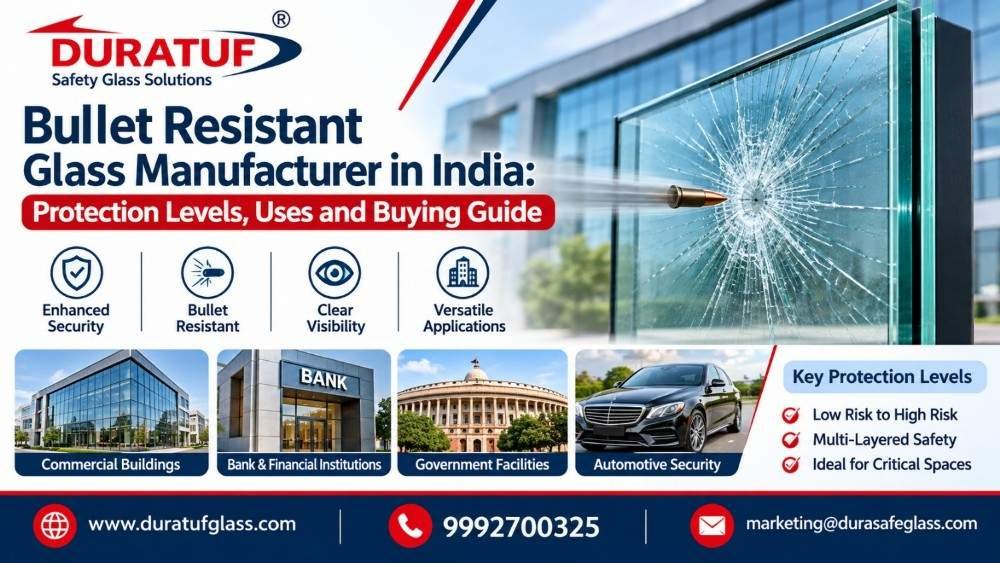
Bullet resistant glass is built to slow down and stop projectiles while still letting you see through it. If you are looking for a bullet resistant glass manufacturer in India, you probably want clear answers on how it works, what levels exist and how to pick the right one. This guide covers all of that in simple words.
Quick Answer: What Is Bullet Resistant Glass?
Bullet resistant glass is a multi-layer laminated glass made from several glass sheets and tough interlayers, and sometimes polycarbonate. When a projectile hits, the layers absorb and spread the energy so the bullet does not pass through. The term “bulletproof” is often used, but experts prefer “bullet resistant” because every product is tested to stop specific threats, not every threat. You can read the general background on Wikipedia.
How Bullet Resistant Glass Works
The glass does not rely on being hard alone. Instead it works as a system:
- Outer glass layers break the bullet’s tip and begin to spread the impact.
- Flexible interlayers absorb energy and hold fragments together.
- Inner layers protect the person behind the glass from flying pieces, often called spall.
The more layers and the greater the total thickness, the higher the protection. That is why a bullet resistant glass is heavier and thicker than ordinary laminated glass.
Types of Bullet Resistant Glass
| Type | Construction | Main Advantage | Typical Use |
| All-glass laminate | Several glass sheets bonded with interlayers | Excellent clarity and scratch resistance | Buildings, counters, control rooms |
| Glass-clad polycarbonate | Glass outside, polycarbonate inside | Lighter weight, spall protection | Vehicles, high-security areas |
| Polycarbonate laminate | Layered polycarbonate | Very light | Special applications |
Where Bullet Resistant Glass Is Used
- Armoured and security vehicles. Windows and windshields that protect occupants during transit.
- Banks and cash counters. Transparent barriers that keep staff safe.
- Control rooms and secure offices. Areas where visibility and safety are both needed.
- Government and protected buildings. Entrances, guard posts and reception areas.
- Jewellery stores and retail counters. Protection against forced entry and theft.
- Railways and transport hubs. Operator cabins and ticket windows.
Duratuf Glass supplies glass for paramilitary and high-security vehicles, which makes this a core area of its work. See the bullet-resistant glass range.
Understanding Protection Levels
Protection is measured through ballistic tests. Internationally recognised systems such as EN 1063 and UL 752 define levels based on the type of ammunition and the speed of the projectile. In simple terms:
- Lower levels protect against handgun threats.
- Mid levels protect against higher-energy handgun and some rifle threats.
- Higher levels protect against high-power rifle rounds.
Always ask the manufacturer which test standard and which level applies to the exact glass build you are buying. Do not rely on thickness alone.
Bullet Resistant Glass vs Normal Laminated Glass
| Feature | Normal Laminated Glass | Bullet Resistant Glass |
| Layers | Two glass layers and one interlayer | Multiple glass and interlayer or polycarbonate layers |
| Thickness | Thin to medium | Medium to very thick |
| Weight | Lighter | Much heavier |
| Purpose | Safety against breakage | Protection against ballistic threats |
| Testing | General safety tests | Ballistic tests to a recognised standard |
For everyday safety needs, standard laminated glass is often enough. For real security risks, only tested bullet resistant glass should be used.
What to Check Before Choosing a Bullet Resistant Glass Manufacturer in India
- Ballistic test proof. Ask for test reports to a recognised standard for the exact product.
- Manufacturing control. Lamination, edge finishing and quality checks should happen in a controlled process.
- Application knowledge. Vehicle glass and building glass have different needs, such as weight limits, curvature and framing.
- Frame and installation support. Glass is only as strong as the frame that holds it. Ask about compatible framing.
- Shape, size and visibility needs vary by project.
- Regulatory awareness. Rules for armoured vehicles and protected buildings may apply. Check guidance from the Ministry of Road Transport and Highways and standards through the Bureau of Indian Standards.
Common Mistakes to Avoid
- Buying on thickness alone without a test level.
- Using bullet resistant glass in a weak frame.
- Ignoring the weight of the glass when planning a vehicle or door.
- Choosing the highest level when a lower level matches the actual risk.
- Skipping a technical discussion with the manufacturer.
Care and Handling
- Clean with a soft cloth and mild cleaner.
- Never use sharp tools on the surface.
- Check edges and seals regularly.
- Replace any panel that has taken a hit, even if it looks fine. Its protection is reduced after impact.
Why Duratuf Glass for Bullet Resistant Glass
Duratuf Glass has been in the glass industry since 1986 and works with automobile, railway and high-security segments. Its range also includes toughened glass, insulating glass and aluminium windows with glass, so you can source related glazing from one supplier. To discuss a requirement, visit the contact page or see all solutions.
Frequently Asked Questions (FAQs)
1. Is bullet resistant glass the same as bulletproof glass?
Yes, in everyday use. Technically, no glass is fully bulletproof. It is rated to stop specific threats.
2. How does bullet resistant glass stop a bullet?
Multiple layers absorb and spread the energy so the projectile loses force before it reaches the other side.
3. Why is bullet resistant glass so thick?
Protection comes from layers. Higher levels need more layers, which adds thickness and weight.
4. Can I see clearly through bullet resistant glass?
Yes. Modern products are designed for good optical clarity, though thicker builds may show a slight tint.
5. Can bullet resistant glass be used in vehicles?
Yes. It is widely used in armoured and security vehicles, with design adjusted for weight and curvature.
6. How are protection levels decided?
Through ballistic testing against recognised standards that define ammunition type and speed.
7. Does bullet resistant glass crack when hit?
It may show cracking at the impact point, but the layers are designed to keep the bullet from passing through.
8. Should damaged bullet resistant glass be replaced?
Yes. Protection reduces after impact, so a hit panel should be replaced.
9. Can bullet resistant glass be customised?
Yes. Size, shape and thickness can be made to match the application and required level.
10. How do I choose the right level?
Start with a risk assessment, then match it to a tested level. A good manufacturer will guide you.
Final Thoughts
Choosing a bullet resistant glass manufacturer in India is about proof, process and support. Ask for test reports, understand the level you need, and match the glass to the frame and use. When you are ready, talk to the team through the contact page.