Automotive Glass Manufacturers in India: Types of Vehicle Glass, Standards and Buying Tips
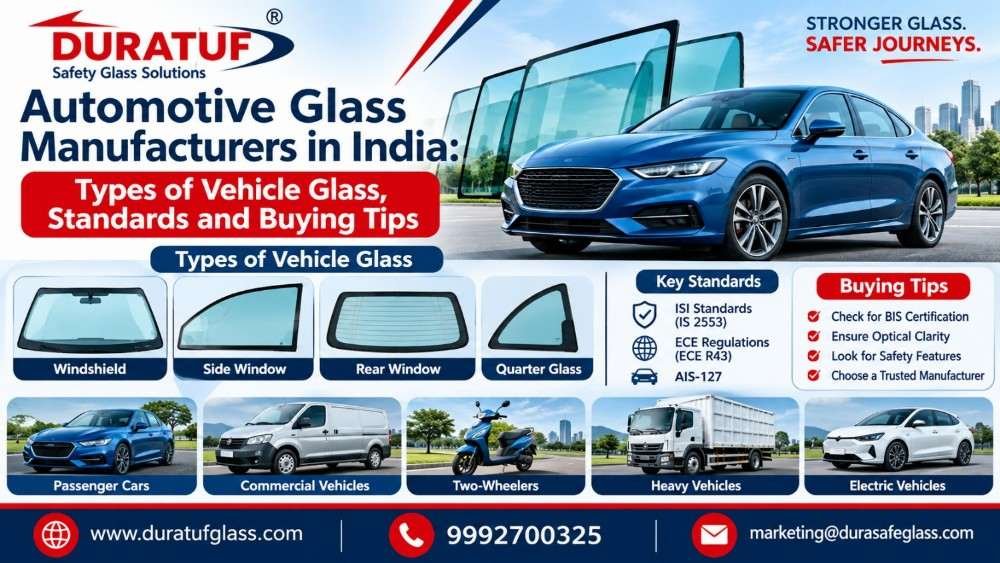
Every vehicle depends on glass for visibility and protection. Automotive glass manufacturers in India supply this glass for cars, buses, trucks, trains and off-road machines. This guide explains the types, the standards and the questions to ask before choosing a supplier.
Quick Answer: What Is Automotive Glass?
Automotive glass is safety glass made specifically for vehicles. Windshields are normally laminated glass, while side and rear windows are often toughened glass. It must give clear vision, handle vibration and impact, and reduce injury in an accident.
Types of Automotive Glass
| Glass Position | Common Glass Type | Why It Is Used |
| Front windshield | Laminated glass | Stays in place when cracked, protects occupants |
| Side windows | Toughened glass | Strong, breaks into small blunt pieces |
| Rear window | Toughened glass | Strength and easy fitment of heating lines |
| Sunroof or roof glass | Toughened or laminated | Depends on design and safety needs |
| Cabin glass for machines | Toughened or laminated | Handles dust, vibration and rough use |
For passenger vehicles see automotive glass for cars. For buses see laminated windshield for buses and side window glass for buses.
How Automotive Glass Is Made
- Cutting glass sheets to the vehicle’s shape.
- Edge grinding for smooth, accurate edges.
- Bending for curved shapes using controlled heat.
- Toughening or laminating, depending on the glass position.
- Printing and fitting features such as black borders, sensors or heating elements where needed.
- Inspection for clarity, shape accuracy and strength.
Accurate curvature matters. If the glass does not match the vehicle body, it can cause fitting problems, leaks or distortion.
Safety and Standards
Vehicle glass in India must meet safety glazing requirements. Motor vehicle rules are set by the Ministry of Road Transport and Highways, and testing and homologation support comes from organisations such as ARAI. Indian standards for safety glass are published through the Bureau of Indian Standards. When you speak to automotive glass manufacturers in India, ask which standards each product meets and request documentation.
What Makes Good Vehicle Glass
- Optical clarity: no waves or distortion in the driver’s view.
- Strength: resistance to impact, vibration and temperature change.
- Accurate fit: correct size, curve and edge finish.
- Durability: long-lasting performance under sun, rain and dust.
- Safety behaviour: correct breakage pattern for the glass position.
Vehicle Segments and Their Glass Needs
Passenger cars
Need precise curvature, clear vision and good noise control.
Buses and coaches
Need large, strong panels and reliable windshields. See aluminium window frames for buses.
Trucks and commercial vehicles
Face long running hours and rough roads, so durability is key.
Agricultural and construction machines
Cabins need tough glass for dust and vibration. See tractor cabin glass, combine cabin glass and backhoe loader glass.
Rail and security vehicles
Need specialised safety and, in some cases, bullet-resistant glass.
How to Choose Among Automotive Glass Manufacturers in India
- Check vehicle experience. Look for experience in your vehicle type.
- Ask about tooling and templates. Accurate shapes need good tooling.
- Confirm testing. Ask what tests are done on every batch.
- Evaluate lamination and toughening capability. Both should be available in-house for flexibility.
- Ask about customisation. Different models need different shapes and tints.
- Review supply reliability. Production lines cannot wait for glass.
- Check regional presence. Nearby plants shorten delivery times.
Common Mistakes
- Choosing glass by price or look alone and ignoring standards.
- Using the wrong glass type in a position that needs laminated glass.
- Ignoring curvature accuracy.
- Skipping sample approval before bulk supply.
Why Duratuf Glass Is Among the Automotive Glass Manufacturers in India to Consider
Duratuf Glass has supplied the automobile, bus, railway and off-road segments since 1986. It manufactures laminated glass and toughened glass with plants in Haryana, Delhi, Madhya Pradesh and Karnataka. Visit the solutions page or the contact page for details.
Frequently Asked Questions (FAQs)
1. What do automotive glass manufacturers in India make?
Windshields, side windows, rear windows, cabin glass and related vehicle glazing.
2. Which glass is used for car windshields?
Laminated glass, because it holds together when cracked.
3. Which glass is used for side windows?
Usually toughened glass, which breaks into small blunt pieces.
4. Why is accurate curvature important?
It ensures proper fit, sealing and clear vision without distortion.
5. Can vehicle glass be customised?
Yes. Shape, thickness, tint and printing can be matched to vehicle design.
6. Is laminated glass better than toughened glass for vehicles?
Each has its place. Laminated glass suits windshields, and toughened glass suits side and rear windows.
7. Does vehicle glass reduce noise?
Laminated glass especially helps reduce road and wind noise.
8. How do I know if vehicle glass meets standards?
Check markings on the glass and ask the manufacturer for documentation.
9. Can the same manufacturer supply buses, trucks and cars?
Many can, though experience may differ by segment. Ask for relevant capability.
10. How do I enquire with Duratuf Glass?
Use the contact page and share the vehicle type, quantity and drawings.
Final Thoughts
Strong automotive glass manufacturers in India combine accuracy, safety and dependable supply. Define your vehicle needs, ask about standards and test practices, and approve samples before bulk orders. To start, reach out via the contact page.