
Glass Manufacturing Company in India: 2026 Industry Guide
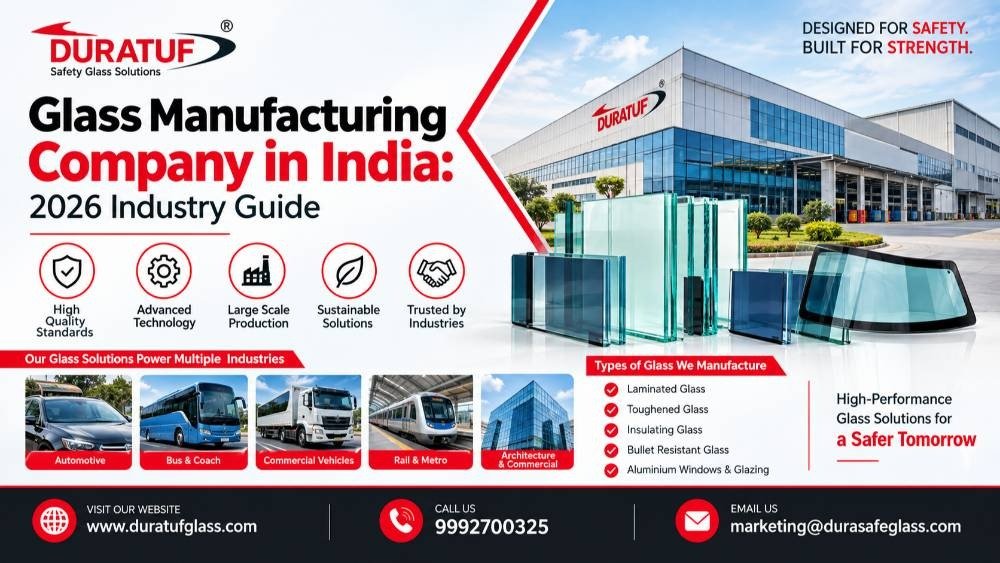
Glass rarely gets a second glance once it is installed, yet almost every building, vehicle and solar panel around us depends on it. Behind that invisibility sits a genuinely large and fast-moving industry, and choosing the right glass manufacturing company in India has become an important decision for architects, OEMs, fabricators and retailers alike.
This guide looks at how India’s glass manufacturing sector is structured, which segments are growing fastest, the standards that separate serious manufacturers from traders, and what buyers should check before committing to a long-term supply relationship.
How India’s Glass Manufacturing Industry Is Structured
India’s glass industry is generally split into a handful of broad categories, each with its own dedicated manufacturers:
| Segment | What It Covers | Typical End Use |
| Float / Flat Glass | Base clear, tinted and coated glass sheets | Windows, facades, mirrors, further processing |
| Automotive Safety Glass | Toughened and laminated windshields and side glass | Cars, buses, trucks, off-highway vehicles |
| Architectural / Processed Glass | Toughened, laminated, insulated, Low-E units | Commercial and residential construction |
| Container & Specialty Glass | Bottles, jars, pharma vials, tableware | FMCG, pharmaceuticals, hospitality |
| Solar & Technical Glass | Photovoltaic module glass, fibre glass | Renewable energy, industrial insulation |
India’s flat glass market alone — the raw material that feeds most of these downstream segments — was valued at around USD 3.9 billion in 2025 and is projected to reach USD 6.4 billion by 2034, growing at a compound annual rate of roughly 5.55%. Growth is being driven by a mix of green-building construction, expanding photovoltaic installations, and steadily rising vehicle production across passenger, commercial and off-highway segments.
Leading Glass Manufacturers Operating in India
India’s glass manufacturing landscape includes both large integrated float-glass producers and specialised processors focused on automotive, architectural or security glass. Well-known names in the sector include multinational float glass producers with plants across Tamil Nadu, Gujarat and Rajasthan, alongside India’s only fully domestically-owned float glass manufacturer, which recently confirmed plans to add up to 700,000 tonnes of annual capacity through new float and solar-glass lines. Government trade authorities have also recommended extending anti-dumping duties on cheaper imported float glass, a sign of how seriously domestic manufacturing capacity is now being protected and prioritised.
Alongside these large float glass players, a wide network of specialised processors focuses specifically on toughened, laminated and safety glass for automotive OEMs, bus body builders, construction equipment manufacturers and architectural fabricators. DURATUF Glass Industries, established in 1992, is one such specialist, operating a conglomerate of seven manufacturing units across Delhi, Haryana, Indore and Bangalore.
How Float Glass Becomes Finished Product
- Melting — sand, soda ash and limestone are melted at high temperature into molten glass
- Floating — the molten glass is floated on a bed of molten tin to form a flat, even sheet
- Annealing — controlled cooling relieves internal stress in the glass
- Cutting — sheets are cut to standard or custom sizes for downstream processing
- Processing — toughening, lamination, coating or insulated-unit assembly is applied depending on end use
- Quality testing — panels are checked against IS 2553 or relevant standards before dispatch
Certification and Quality: What a Genuine Manufacturer Should Show You
The Bureau of Indian Standards (BIS) requires that safety glass sold in India be procured only from certified manufacturers, with products carrying a permanent, indelible marking that identifies the manufacturer and applicable standard. For safety glass specifically, IS 2553 (Part 1):2018 covers general-purpose applications such as architecture, furniture and earth movers, while IS 2553 (Part 2):2019 addresses safety glass used in road transport vehicles.
A genuine glass manufacturing company in India should be able to produce these certificates without hesitation, along with test reports for the specific product type and thickness a buyer is ordering. Traders and resellers, by contrast, often cannot provide direct mill or factory documentation, which is one of the simplest ways to tell the two apart during due diligence.
What Drives Growth in Indian Glass Manufacturing
- Construction and real estate expansion across metros and tier-2 cities
- Rising vehicle production across passenger cars, commercial vehicles and electric vehicles
- Green building mandates requiring higher-performance architectural glazing
- Government support through Make in India and Production Linked Incentive schemes for auto components
- Protective trade measures on cheaper imported float glass, encouraging domestic capacity investment
- Renewable energy growth increasing demand for solar module glass
Choosing the Right Glass Manufacturing Company in India
- Ownership of processing — does the company actually melt, temper or laminate glass, or does it outsource and resell?
- Certification — current BIS/IS 2553 certificates with verifiable markings on delivered glass
- Production footprint — multiple manufacturing units generally mean better resilience against delays
- Segment expertise — automotive, architectural, security and industrial glass each demand different tooling and expertise
- Export track record — international shipments are a reasonable proxy for consistent quality control
- Client references — OEM approvals or long-standing institutional clients in your sector
DURATUF Glass Industries: A Multi-Segment Manufacturer
DURATUF Glass Industries has built its business over more than three decades around one principle: process glass in-house rather than outsourcing it. The company’s seven manufacturing units serve automotive OEMs including Ashok Leyland, Tata Motors, Volvo, SML Isuzu, Eicher, M&M, Scania, Bharat Benz and HM, alongside bus body builders, State Transport Undertakings, and architectural and security-glass clients.
The company’s product range includes toughened and laminated glass for buses and light commercial vehicles, specialised glazing for construction equipment cabins such as backhoe loaders, and bullet-resistant panels for security applications, in addition to large-format architectural glass. Products are exported to Bangladesh, Sri Lanka and Nepal, reflecting the kind of consistent, in-house quality control that larger buyers look for when shortlisting a long-term manufacturing partner.
To explore the complete range of products or request a technical quotation, visit DURATUF’s solutions page or contact the sales and technical team directly with your project specifications.
Emerging Trends in Indian Glass Manufacturing
- Capacity expansion among domestic float glass producers to reduce reliance on imports
- Solar glass demand rising in step with India’s renewable energy targets
- Smart and switchable glass entering premium architectural and automotive segments
- Lightweighting for electric vehicles, favouring thinner, high-strength laminated glass
- Sustainability through recycled cullet use and lower-emission furnace technology
Frequently Asked Questions (FAQs)
- What is the difference between a float glass manufacturer and a glass processor?
A float glass manufacturer melts raw materials into base glass sheets, while a processor takes that base glass and tempers, laminates, coats or cuts it into finished products for specific applications.
- How can I confirm a glass manufacturing company in India is genuine and not a reseller?
Ask for factory audit access, BIS/IS 2553 certification specific to the product ordered, and direct mill test reports rather than generic marketing documentation.
- Which industries buy the most glass in India?
Construction and real estate, automotive and commercial vehicles, and increasingly renewable energy through solar module glass, together account for the bulk of domestic glass demand.
- Are Indian glass manufacturers able to compete with imported glass?
Yes, and government trade measures such as anti-dumping duties on selected imports have been used specifically to protect domestic manufacturing capacity from undercutting by cheaper overseas glass.
- What certifications should a serious glass manufacturing company in India hold?
At minimum, BIS certification under the relevant IS standard for the product category, such as IS 2553 for safety glass, along with any sector-specific approvals like OEM vendor certification for automotive supply.
- Can one manufacturer supply both automotive and architectural glass?
Yes, several established Indian manufacturers, including DURATUF, operate across both segments from the same manufacturing network, which can simplify sourcing for diversified buyers.
- How long does it take to set up a supply relationship with a new glass manufacturer?
Timelines vary, but sample approval, certification verification and a trial order typically take a few weeks before a manufacturer is confirmed as a regular supply partner.
- Do Indian glass manufacturers export internationally?
Several manufacturers export to neighbouring markets such as Bangladesh, Sri Lanka and Nepal, and in some categories further afield, reflecting growing confidence in Indian-made glass quality.
- What is driving capacity expansion among Indian glass manufacturers right now?
Rising domestic construction and vehicle production, government incentive schemes, and protective trade measures against cheaper imports are together encouraging manufacturers to expand float and processing capacity.
- Is it better to source glass locally or from a larger national manufacturer?
Larger manufacturers with multiple production units generally offer more consistent quality, certification and delivery reliability for bigger projects, while local processors can suit smaller, one-off requirements.
Conclusion
India’s glass manufacturing sector has matured considerably over the past decade, moving from fragmented, import-reliant supply toward a more consolidated base of certified domestic producers. For buyers, that shift makes the choice of glass manufacturing company in India more important than ever — certification, in-house processing capability and a genuine production track record now separate serious manufacturers from resellers riding on someone else’s factory output.
Whether the requirement is float glass for a new facade, toughened safety glass for a vehicle programme, or specialised laminated panels for a security application, partnering with an established, BIS-certified manufacturer remains the most reliable route to consistent quality and long-term supply stability.