Commercial Glass Manufacturer India: Types, Uses & Guide
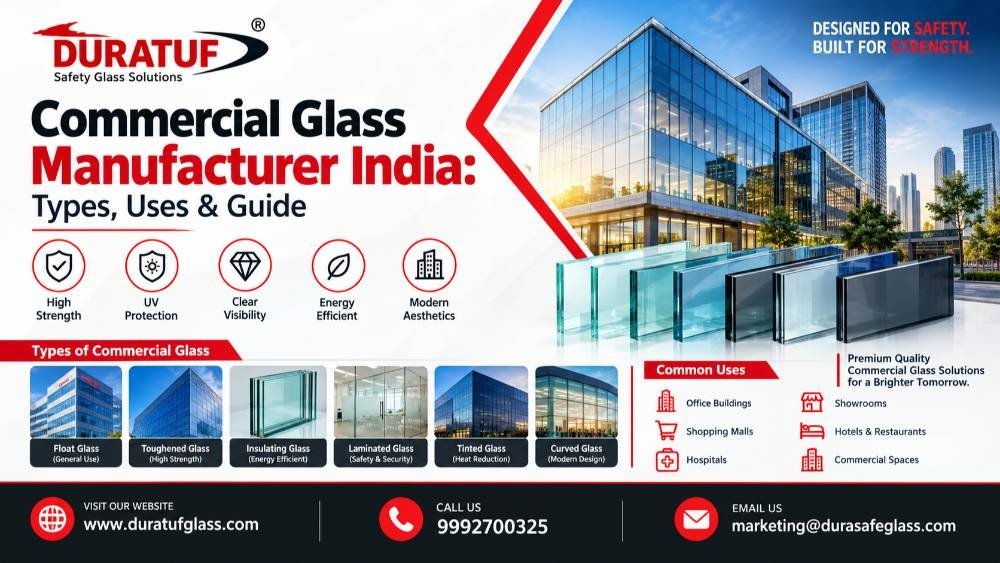
Walk through any business district in Gurugram, Bengaluru or Pune today and the skyline tells its own story: glass facades, glazed storefronts and glass-fronted offices have become the default language of modern commercial architecture. Behind every one of those buildings sits a commercial glass manufacturer India developers trust to deliver panels that are strong, energy-efficient and consistent at scale.
This guide breaks down what commercial glazing actually involves, why the sector is expanding so quickly, which standards genuinely matter, and what to check before signing a supply contract with any glazing partner.
What Counts as Commercial Glass?
Before comparing suppliers, it helps to understand exactly what falls under the commercial glass category, since the term covers a wider range of products than most first-time buyers expect.
Commercial glass covers the glazing used in offices, retail stores, hotels, hospitals, institutional buildings and light commercial vehicles — essentially any application outside pure residential housing or heavy industry. It typically includes curtain walls, storefronts, skylights, partitions, canopies and glazed doors, along with the specialised light and vision glasses used in commercial fleets and delivery vehicles.
| Glass Type | Core Benefit | Common Commercial Use |
| Tempered (Toughened) Glass | 4-5x stronger than annealed glass, breaks safely into small pieces | Doors, partitions, storefronts, balustrades |
| Laminated Glass | Holds together on impact, blocks UV and reduces noise | Facades, skylights, ground-floor glazing |
| Insulated Glass Units (DGU) | Two panes with a sealed air/gas gap for thermal insulation | Curtain walls, office windows, cold climates |
| Low-E (Low-Emissivity) Glass | Reflects heat while allowing daylight through | Energy-efficient facades and glazed offices |
| Reflective / Tinted Glass | Cuts glare and solar heat gain | West-facing facades, retail frontages |
Why the Commercial Glazing Market in India Is Growing
India’s flat glass market, the base material behind most commercial glazing, was valued at around USD 3.9 billion in 2025 and is projected to reach USD 6.4 billion by 2034, supported by rapid urbanisation, a growing pipeline of green-certified buildings, and rising demand for glass in photovoltaic and e-glass structures. Commercial real estate in metros such as Mumbai, Bengaluru and Delhi NCR continues to expand, and every new office park or retail development adds to the pipeline of glazing orders.
Sustainability regulation is a major growth driver too. The Energy Conservation Building Code (ECBC), which applies to commercial buildings with a connected load of 100 kW or more, or a built-up area above 1,000 square metres, sets minimum performance standards for building envelopes, including glazing. Compliant buildings can achieve energy savings of 25-50%, and glass performance is one of the biggest levers available to hit those targets, since a well-specified facade reduces both heat gain and lighting load simultaneously.
Green building certification bodies have reinforced this trend further. As the Indian Green Building Council (IGBC) movement has expanded over the past two decades, architects have increasingly turned to high-performance glazing — insulated units, Low-E coatings and solar-control laminates — to meet certification benchmarks without sacrificing the daylight and visual openness clients now expect as standard.
Curtain Walls, Storefronts and Facades: Where Design Meets Performance
A commercial glass manufacturer India architects rely on has to balance two competing demands: visual openness and thermal performance. As one industry overview on glazing selection puts it, glass “does not matter if you are in the mild but wet and windy climate of Bengaluru or in the extreme hot and dry climate of Gurgaon” — the specification simply has to change with the climate zone, which is why generic, one-size-fits-all glazing rarely performs well across India’s varied geography.
- Building orientation — the direction a facade faces changes how much solar heat it absorbs through the day
- Climate zone — hot-dry, warm-humid, composite and cold regions each call for different coatings
- Local building codes — ECBC and state-level amendments set minimum energy performance thresholds
- Acoustic requirements — busy commercial corridors often need laminated or acoustic-grade glazing
- Aesthetic brief — reflective, tinted, ceramic-printed or clear glass all create a different street presence
Safety and Quality Standards for Commercial Glass in India
Commercial glazing in India sits under the same umbrella of safety-glass regulation that governs automotive and architectural glass. The Bureau of Indian Standards (BIS) requires safety glass to be procured only from certified manufacturers, with IS 2553 setting out sampling methods, test requirements and permanent markings for traceability. For commercial buildings specifically, the National Building Code (NBC), developed by BIS, adds further guidance covering general requirements, thickness determination, human-impact safety, installation, fire safety and thermal performance.
Buyers commissioning large glazing packages — a new office tower, a retail chain roll-out, or a hospital extension — should always confirm that the commercial glass manufacturer India is supplying from carries current BIS certification and can produce test documentation on request, rather than relying on verbal assurances alone.
How to Choose the Right Commercial Glass Manufacturer in India
- Production capacity and lead time — can the supplier handle the full order in one continuous batch to avoid colour or thickness variation?
- Certification and testing — IS 2553 and NBC compliance, backed by test reports rather than claims
- Range of processing — tempering, lamination, insulated unit assembly and coating under one roof reduces handling risk
- Project references — completed commercial or institutional projects of comparable scale
- Technical support — guidance on glazing selection by climate zone and building orientation
- Logistics and delivery track record — large glass panels are fragile and delicate to transport safely
DURATUF: A Versatile Commercial Glass Manufacturer in India
DURATUF Glass Industries, founded in 1992, operates a conglomerate of seven manufacturing units across Delhi, Haryana, Indore and Bangalore, supplying glass and glazing products across automotive, security, architectural and commercial segments in India and abroad. The company’s product range spans toughened, laminated, bullet-resistant and large-format glass, including panels as large as 1.83 m by 2.6 m, which suits the scale most commercial projects demand.
For commercial and light commercial vehicle fleets, DURATUF supplies dedicated commercial light glasses built for durability and daily wear, along with refrigerated vehicle glazing for temperature-controlled logistics fleets, and bullet-resistant glass for banks, cash-in-transit vehicles and security enclosures. This breadth of processing capability, developed over more than three decades, is exactly what larger commercial buyers look for when consolidating vendors.
To discuss a specific commercial glazing requirement, you can browse DURATUF’s full solutions range or reach out to the sales team directly with your drawings and technical specification.
Common Mistakes Businesses Make When Sourcing Commercial Glass
- Choosing on lowest quote alone without checking certification, leading to compliance issues later
- Ignoring climate-specific performance and using the same specification across very different sites
- Underestimating lead times for large-format or custom-coated glass, causing project delays
- Skipping sample approval before committing to a full production run
- Overlooking after-sales support for breakage replacement once the building is occupied
Frequently Asked Questions (FAQs)
- What is the difference between commercial glass and residential glass?
Commercial glass is generally specified to higher structural, fire-safety and energy-performance standards because of larger spans, taller elevations and occupancy codes that apply to offices, retail and institutional buildings.
- Is tempered or laminated glass better for commercial facades?
Both have a role. Tempered glass offers strength and safe breakage, while laminated glass adds retention after impact and better acoustic performance, which is why many facades combine both properties in a single unit.
- Do commercial buildings in India need ECBC-compliant glazing?
Buildings with a connected load of 100 kW or more, a contract demand of 120 kVA or more, or a built-up area above 1,000 square metres fall under ECBC, which sets minimum thermal and energy performance requirements including for glazing.
- What is Low-E glass and why is it used commercially?
Low-emissivity glass carries a thin coating that reflects heat while letting daylight through, helping reduce cooling costs in glazed commercial buildings without darkening the interior significantly.
- How do I verify a commercial glass manufacturer India is BIS certified?
Ask for the relevant IS 2553 certificate and check that delivered glass carries the required permanent marking; reputable manufacturers will provide this documentation without hesitation.
- Can the same manufacturer supply both building glass and vehicle fleet glass?
Yes, several established Indian manufacturers, including DURATUF, supply both architectural and commercial vehicle glazing from the same production network, which can simplify vendor management for larger organisations.
- How long does insulated glass typically last in a commercial building?
A well-sealed insulated glass unit typically performs for 15 to 25 years before seal failure becomes likely, though this depends on installation quality, climate exposure and glass specification.
- What factors affect lead time for a large commercial glazing order?
Panel size, coating or lamination requirements, current production backlog and logistics distance all affect lead time, so it helps to confirm timelines in writing before project scheduling begins.
- Does commercial glass need to be fire rated?
Certain applications, such as fire-rated partitions or escape routes, do require fire-rated glazing under building safety codes, so it is important to specify this separately from standard structural or thermal requirements.
- What should be included in a commercial glazing RFQ?
A clear RFQ should include panel dimensions, glass type and thickness, coating or lamination requirements, quantity, project timeline and the applicable building code, so the manufacturer can quote accurately the first time.
- Why do large developers prefer a single commercial glass manufacturer India-wide?
Consolidating orders with one certified manufacturer reduces batch-to-batch variation in colour, thickness and coating performance, and simplifies coordination across multi-site projects with a single point of technical contact.
Conclusion
Commercial glazing has moved well beyond simply filling an opening — it now plays a direct role in a building’s energy performance, occupant comfort and architectural identity. Working with an established commercial glass manufacturer India developers and fleet operators already trust helps ensure certified quality, predictable lead times and glass that performs exactly as specified, from the first day of occupancy through decades of use.
Whether the requirement is a full curtain wall, a retail storefront, or specialised glazing for a commercial vehicle fleet, getting the specification and certification right at the outset saves both cost and disruption later in the project.