
Laminated Glass Manufacturer in India: Complete 2026 Guide
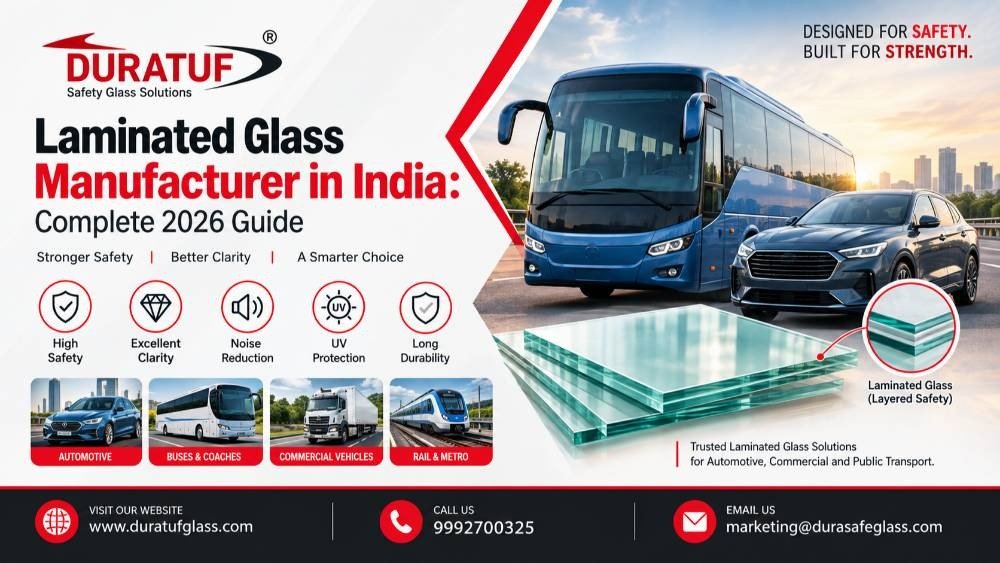
Glass has quietly become one of the most trusted safety materials in modern India, and the reason lies in a single, clever idea: bond two panes together with a tough plastic film so the glass holds its shape even after it cracks. That is laminated glass, and the search for a dependable laminated glass manufacturer in India has grown sharply as builders, OEMs and homeowners look for glazing that protects people rather than just filling an opening.
From skyscraper facades in Mumbai to bus windshields rolling out of Pithampur, laminated glass sits at the intersection of safety regulation, architectural ambition and everyday practicality. This guide walks through what laminated glass actually is, why demand for a trusted safety glass supplier keeps rising, the standards that separate genuine laminated safety glass from the rest, and how to choose a producer you can rely on for long-term supply.
What Is Laminated Glass, and Why Does It Matter?
Laminated glass is made by sandwiching a transparent interlayer, most commonly polyvinyl butyral (PVB), between two or more sheets of glass and fusing them together under heat and pressure in an autoclave. If the glass is struck, it can crack, but the interlayer holds the fragments in place rather than letting them scatter. That single property is why laminated glass is specified for windshields, high-rise facades, skylights, balustrades and security screens across the country.
A capable laminated safety glass producer will typically offer more than one interlayer option, because different projects call for different performance. Understanding these variants also helps buyers ask the right questions before signing off on a supply contract:
| Interlayer Type | Typical Thickness | Best Suited For |
| PVB (Polyvinyl Butyral) | 0.38 mm – 1.52 mm | Windshields, facades, balustrades, general safety glazing |
| EVA (Ethylene Vinyl Acetate) | 0.38 mm – 0.76 mm | Solar modules, decorative and coloured laminates |
| Ionoplast (SentryGlas type) | 0.89 mm – 1.52 mm | Structural glazing, hurricane and blast-resistant panels |
| Acoustic PVB | 0.76 mm – 1.14 mm | Noise-sensitive facades, recording studios, hospitals |
Why Demand for Laminated Glass Manufacturing Is Rising in India
Several trends are converging at once. Globally, the laminated glass market is projected to grow from roughly USD 24.74 billion in 2025 to USD 26.67 billion in 2026, and laminated glass is expected to remain the single largest product category within the wider advanced glass market, holding around 40.5% share in 2026 according to industry estimates. India is one of the fastest-growing markets within this category, with several analysts placing the country’s growth rate among the highest worldwide for the coming decade, second only to China.
Closer to home, India’s flat glass market — the base material from which laminated glass is produced — was valued at around USD 3.9 billion in 2025 and is projected to reach USD 6.4 billion by 2034, helped along by rising construction activity, stricter road-safety rules for vehicle glazing, and a fast-expanding electric vehicle segment that needs lightweight, acoustically superior glass. Rapid urbanisation, an expanding stock of commercial real estate, and a growing appetite for high-rise residential towers are all adding to this pipeline of demand. Every one of these forces points to the same conclusion: buyers need a production partner who can scale, certify and deliver consistently, year after year.
It is worth noting that construction and automotive are not the only sectors pulling this demand forward. Renewable energy is playing an increasingly important role too, since EVA-laminated glass is now a standard component in photovoltaic modules, and India’s solar capacity additions continue to climb every year. Defence and banking procurement, which require ballistic-rated multi-ply laminates, add a smaller but steady stream of specialised orders on top of this broader growth curve.
Where Laminated Glass Is Used
A reliable laminated glass manufacturer in India rarely serves just one industry. The same core process — bonding glass with a PVB or ionoplast interlayer — is adapted across several very different sectors:
| Sector | Typical Application | Why Laminated Glass Is Chosen |
| Automotive & Commercial Vehicles | Windshields, driver cabins, bus and truck glazing | Retains vision after impact, meets IS 2553 safety norms |
| Architecture & Real Estate | Facades, skylights, canopies, glass floors | Holds together on breakage, reduces fall-through risk |
| Security & Defence | Bullet-resistant screens, ATM enclosures, banks | Multi-ply laminates absorb and stop projectile force |
| Renewable Energy | Solar photovoltaic module glass | EVA-laminated glass protects cells and improves durability |
| Interiors & Acoustic Spaces | Partitions, staircases, balustrades, studios | Acoustic PVB cuts noise transmission significantly |
IS 2553 and BIS Certification: What a Genuine Producer Must Meet
Unlike ordinary float glass, laminated safety glass sold in India is governed by the Bureau of Indian Standards (BIS) under IS 2553. The standard is split into two parts that any serious safety glass manufacturer should be able to speak to confidently:
- IS 2553 (Part 1):2018 – Lays down general requirements, sampling methods and test procedures for safety glass used in architecture, furniture, railway coaches, earth movers and general fixtures.
- IS 2553 (Part 2):2019 – Sets out specific requirements for safety glass used in road transport vehicles, including windshields and side glazing.
- Every panel is expected to carry a permanent, indelible marking identifying the manufacturer, standard and glass type, so buyers can trace compliance at any point.
For architects and OEMs alike, BIS certification is not a paperwork formality. Non-compliant glass can fail to protect occupants, shatter dangerously on impact, or create legal liability if it is ever involved in an accident or structural failure. Confirming IS 2553 compliance is the single most important step before finalising any supply agreement, and it is a question every buyer should ask upfront rather than assume.
What to Look for Before You Finalise a Supplier
- BIS/IS 2553 certification with visible, verifiable markings on delivered glass
- In-house autoclave and lamination capacity rather than outsourced processing, which affects lead time and quality control
- OEM approvals and track record with recognised automotive, construction or defence clients
- Range of interlayer options — PVB, acoustic PVB, ionoplast and EVA — for different project needs
- Large-format production capability for facades, bus glazing and bigger architectural panels
- Export experience that signals consistent international quality control
- After-sales and technical support for installation guidance and warranty claims
DURATUF: A Trusted Laminated Glass Manufacturer in India
DURATUF Glass Industries, established in 1992, has grown into a conglomerate of seven manufacturing units spread across Delhi, Haryana, Indore and Bangalore, producing both flat and curved laminated glass for automotive, architectural and security applications. DURATUF’s laminated windshields use a two-layer glass construction bonded with a PVB interlayer, and the company’s glass is relied upon by OEMs including Ashok Leyland, Tata Motors, Volvo, SML Isuzu, Eicher, M&M, Scania, Bharat Benz and HM.
Beyond passenger and commercial vehicles, DURATUF also supplies laminated and toughened glass for buses and light commercial vehicles, bus side windows, and bullet-resistant laminated panels for security enclosures and armoured applications, alongside laminated glazing for construction equipment cabins such as backhoe loaders. The company’s products are also exported to Bangladesh, Sri Lanka and Nepal, which speaks to the consistency expected of an established, export-ready producer.
To review the full product range or speak with the team about a specific requirement, you can explore DURATUF’s solutions or get in touch with their sales team. Sharing your drawing, thickness requirement and application upfront usually speeds up the quoting process considerably.
Factors That Influence Your Choice, Beyond Cost
Buyers understandably compare quotes, but price alone rarely tells the full story with safety glass. Lead time, interlayer quality, edge-sealing technique and after-sales support around breakage or warranty claims often matter far more over the life of a project. A supplier offering the lowest quote but no verifiable IS 2553 documentation, or no track record with comparable projects, can end up costing far more in rework, delays or compliance issues down the line. It pays to request sample panels, ask for third-party test reports, and speak to at least one existing client with a project of similar scale before committing.
Future Trends Shaping Laminated Glass Manufacturing in India
- Ionoplast interlayers are gaining ground for thinner, structurally stronger panels in high-rise facades
- Electric vehicle glazing is driving demand for lighter, acoustically superior laminated glass
- Solar-control and low-emissivity laminates are being combined to cut cooling loads in buildings
- Smart and switchable laminated glass is entering premium architectural and automotive segments
- Capacity expansion among Indian manufacturers is being encouraged by Production Linked Incentive support for auto components
Frequently Asked Questions (FAQs)
- What makes laminated glass different from toughened glass?
Toughened glass is heat-treated to break into small, blunt granules, while laminated glass uses an interlayer that holds cracked fragments in place. Many facades and vehicle windscreens combine both properties through toughened-laminated construction.
- How do I verify that a laminated glass manufacturer in India is BIS certified?
Ask for the IS 2553 Part 1 or Part 2 certificate relevant to your application and check that delivered panels carry the permanent, indelible marking required by the Bureau of Indian Standards.
- Is laminated glass suitable for residential balconies and staircases?
Yes. Laminated glass is widely specified for balustrades, glass floors and staircases because it holds together if cracked, reducing the risk of a fall-through accident.
- Can laminated glass be made bullet resistant?
Yes. By increasing the number of glass and interlayer plies, laminated glass can be engineered to meet ballistic resistance standards for banks, cash vans and security enclosures.
- What thickness of PVB interlayer is normally used?
Standard architectural and automotive laminates typically use 0.38 mm to 0.76 mm PVB, while acoustic or structural applications may use thicker interlayers up to 1.52 mm depending on the performance required.
- Does laminated glass reduce outside noise?
Acoustic PVB interlayers are specifically formulated to dampen sound transmission and are commonly specified for facades near busy roads, airports or industrial zones.
- How long does laminated glass typically last?
With proper installation and edge sealing, laminated glass commonly performs reliably for 20 to 30 years or more, though lifespan depends on exposure, maintenance and the quality of the original lamination.
- Are Indian laminated glass manufacturers able to export?
Several established players, including DURATUF, already export laminated automotive and architectural glass to markets such as Bangladesh, Sri Lanka and Nepal, reflecting growing international confidence in Indian manufacturing quality.
- What should I check before placing a bulk order?
Confirm IS 2553 certification, ask for sample test reports, review OEM or project references, and check in-house autoclave capacity so lead times remain predictable for large orders.
- Is laminated glass more expensive to install than ordinary glass?
Installation methods are broadly similar to standard glazing, and the long-term safety, security and acoustic benefits generally make laminated glass a sound investment for both residential and commercial projects.
- How do I get a quote from a laminated glass manufacturer in India?
Most manufacturers, including DURATUF, ask for drawings, glass thickness, interlayer type and application details before issuing a formal quotation, so having these specifications ready in advance speeds up the process considerably.
Conclusion
Choosing the right laminated glass manufacturer in India is ultimately a question of trust: trust that the interlayer is bonded correctly, that the glass meets IS 2553, and that the supplier can deliver consistently at scale. With India’s construction and automotive sectors both expanding, producers who combine certified quality with genuine production capacity — such as DURATUF — are increasingly the ones OEMs, architects and fleet operators turn to first.
Whether the requirement is a laminated windshield for a new commercial vehicle, a bullet-resistant screen for a security kiosk, or a full architectural facade, working with an experienced supplier helps ensure the glass performs exactly as intended, long after installation, and continues to protect the people behind it for decades to come.