Commercial Glass Manufacturer India: Types, Uses and How to Choose the Right Partner
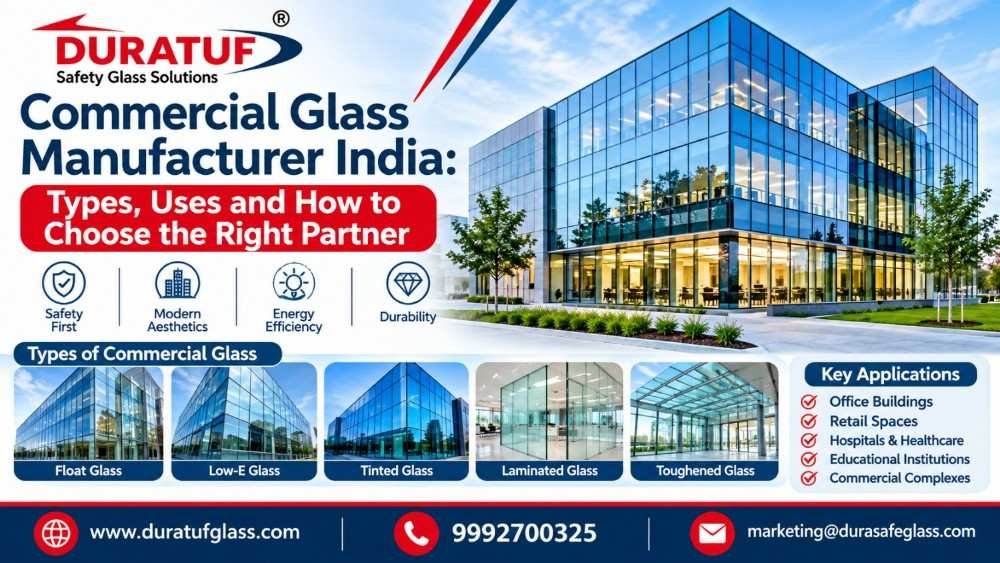
Offices, malls, hotels, airports and railway stations rely heavily on glass. The right glass makes a building safer, brighter and more efficient. This guide explains the main types of commercial glass, how they are used and what to look for in a commercial glass manufacturer India projects can rely on.
Quick Answer: What Is Commercial Glass?
Commercial glass is glass designed for non-residential buildings such as offices, retail spaces, hospitals, hotels and public infrastructure. It is usually thicker, safer and more performance-focused than basic residential glass. It may be toughened, laminated, insulated or coated, depending on the job.
Main Types of Commercial Glass
| Glass Type | What It Does | Typical Commercial Use |
| Toughened glass | High strength and safer breakage | Doors, partitions, storefronts, railings |
| Laminated glass | Stays in place when cracked, reduces noise | Skylights, facades, overhead glazing, security areas |
| Insulating glass | Reduces heat transfer and sound | Windows and curtain walls in air-conditioned buildings |
| Bullet-resistant glass | Protects against ballistic threats | Banks, control rooms, protected entrances |
| Coated or tinted glass | Controls glare and solar heat | Large facades and sun-facing areas |
You can read more about our range on the pages for toughened glass, laminated glass, insulating glass and bullet-resistant glass.
Where Commercial Glass Is Used
- Office buildings. Facades, partitions and meeting rooms use glass for light and a modern look.
- Retail and malls. Storefronts, display areas and atriums depend on strong, clear glass.
- Hotels and hospitality. Lobbies, balconies and railings need safe and attractive glazing.
- Hospitals and institutions. Clean, safe and easy-to-maintain glass is important.
- Airports, metro and railway stations. Large glazed areas need strength, safety and weather resistance.
- Industrial and showroom spaces. Durable glass for doors, windows and display units.
Why Glass Choice Matters in Commercial Buildings
- Safety: Public spaces need glass that does not cause serious injury when broken.
- Energy use: Good glazing reduces the load on air conditioning. Guidance on building efficiency is available from the Bureau of Energy Efficiency.
- Comfort: Sound and glare control improve working conditions.
- Security: Laminated or specialised glass makes forced entry harder.
- Appearance: Glass shapes the identity of a building.
Key Features to Look for
- Correct thickness for the span and wind load.
- Edge quality and consistent size.
- Clear optical quality without waves or distortion.
- Compliance with safety standards from the Bureau of Indian Standards.
- Compatibility with the frame and glazing system. Explore aluminium windows with glass for combined solutions.
How to Choose a Commercial Glass Manufacturer India Projects Can Trust
- Check range. A supplier with several glass types can match each area of a building to the right product.
- Ask about processing capacity. Cutting, toughening, laminating and insulating all need proper equipment.
- Look for consistency. Large projects need identical quality across many panels.
- Ask about customisation. Shapes, sizes and finishes should match design drawings.
- Check technical support. Good teams help with specifications and installation questions.
- Confirm delivery planning. Glazing is often on the critical path of a project.
Common Mistakes in Commercial Glass Selection
- Selecting glass only for looks and ignoring safety or energy needs.
- Using the same glass for every location in a building.
- Not checking wind load and span requirements.
- Leaving cut-outs and holes until after toughening.
- Ignoring maintenance access for large glass areas.
Maintenance Tips
- Clean regularly with a soft cloth and mild cleaner.
- Inspect seals and gaskets once a year.
- Replace cracked or chipped panels promptly.
- Avoid harsh chemicals that can damage coatings.
Why Duratuf Glass Is a Reliable Commercial Glass Manufacturer India Buyers Consider
Duratuf Glass has served automobile, railway, architectural and industrial sectors since 1986. It supplies safety glass in several forms and works from plants across Haryana, Delhi, Madhya Pradesh and Karnataka. To see how its products fit different needs, visit the solutions page or contact the team.
Frequently Asked Questions (FAQs)
1. What does a commercial glass manufacturer do?
It produces and processes glass for non-residential buildings, including cutting, toughening, laminating and insulating.
2. Which glass is best for office buildings?
It depends on the area. Toughened glass suits partitions and doors, laminated glass suits overhead and security areas, and insulating glass suits outer windows.
3. Is commercial glass stronger than residential glass?
Usually yes. It is designed for higher traffic, larger sizes and higher safety needs.
4. Can commercial glass reduce energy use?
Yes. Insulating and coated glass reduce heat transfer and help lower cooling needs.
5. Can commercial glass reduce noise?
Yes. Laminated and insulating glass both improve sound control.
6. Is laminated glass good for security?
It is harder to break through than a single sheet and stays in place when cracked, which improves security.
7. Can commercial glass be customised?
Yes. Size, thickness, shape, tint and edge finish can be matched to design needs.
8. How long does commercial glass last?
With proper installation and care, glass can last for decades, though seals and frames may need attention sooner.
9. What should I share with a manufacturer for a quote?
Drawings, sizes, glass type, thickness, quantity, application and delivery location.
10. How can I contact Duratuf Glass for a commercial project?
Use the contact page to share your requirement.
Final Thoughts
The best commercial glass manufacturer India offers is one that understands both the building and the glass. Choose by range, quality control and support, and match every glass type to its location. When you are ready, start with the contact page.