
Glass Manufacturing Company in India: How Glass Is Made
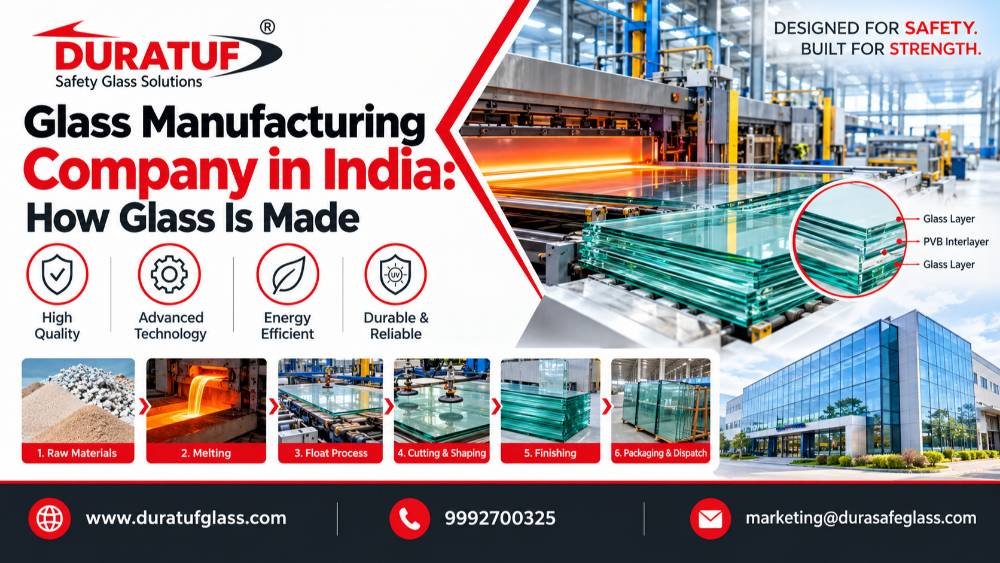
Quick answer: Glass is made by melting sand, soda ash and limestone at very high temperatures, forming it into flat sheets, and cooling it slowly. A glass manufacturing company in India then cuts and processes those sheets into products such as toughened, laminated and insulating glass.
Glass looks simple, but turning raw materials into a safe, clear sheet takes several carefully controlled stages. This article explains the process in plain English, and shows where a glass manufacturing company in India fits into it.
Step 1: Raw materials
The main ingredients are silica sand, soda ash and limestone, along with small amounts of other minerals. Recycled glass, called cullet, is also added because it melts at a lower temperature and saves energy. For a general explanation, see Britannica’s glass overview.
Step 2: Melting
The mixture is heated in a furnace to around 1,500°C until it becomes a thick liquid. Furnaces run day and night because stopping and restarting would damage them.
Step 3: Forming flat glass
Most flat glass is made by the float process. Molten glass flows onto a bath of molten tin, where it spreads out evenly and becomes smooth and flat. You can read more about float glass.
Step 4: Annealing
The glass cools slowly in a long oven called a lehr. Slow cooling removes internal stress, which would otherwise make the sheet weak.
Step 5: Cutting and inspection
Large sheets are inspected for bubbles and flaws, then cut into standard sizes. These sheets are sent to processors.
Step 6: Processing into safety glass
This is the stage where many companies add value. A glass manufacturing company in India that focuses on safety glass will usually work with float glass sheets and process them for specific uses.
| Product | How it is made | Typical use |
| Toughened glass | Heated to about 600–700°C, then cooled rapidly | Side windows, doors, partitions |
| Laminated glass | Glass layers bonded with an interlayer in an autoclave | Windscreens, skylights, security |
| Insulating glass | Two panes sealed with a spacer and gap | Façades, offices |
| Bullet resistant glass | Multiple layers of glass and other materials | Armoured vehicles, banks |
| Glass with aluminium frames | Glass fitted into engineered frames | Windows for buildings and buses |
How toughening works
In a toughened glass line, cut glass passes through a furnace and is then cooled rapidly with air. The outer surface cools first and sets in compression, while the inside stays in tension. This balance makes the glass much stronger and causes it to break into small, blunt pieces. See also tempered glass on Wikipedia.
How lamination works
In laminated glass production, the glass is washed, an interlayer is placed between sheets, air is removed and the stack is bonded in an autoclave. The glass stays together even when cracked.
How insulating glass is made
Two panes are separated by a spacer and sealed, with a gap that reduces heat movement. Quality depends largely on the seal. Take a look at our insulating glass page.
Quality control at each stage
A responsible glass manufacturing company in India checks:
- Raw glass for flaws.
- Dimensions after cutting.
- Edge quality.
- Furnace and autoclave settings.
- Final appearance and strength samples.
Standards such as those from the Bureau of Indian Standards and the International Organization for Standardization guide these checks.
About Duratuf Glass
Duratuf Glass was founded in 1986 by Mr N.C. Gupta and works across buses, trains, off-highway vehicles, white goods, cookware and architecture. With plants in Bahadurgarh (Haryana), Delhi, Pithampur (Madhya Pradesh) and Bangalore, it processes glass for many sectors. See all products on the solutions page.
Frequently asked questions
- What does a glass manufacturing company in India do?
It makes or processes glass into finished products, such as toughened, laminated and insulating glass, for vehicles, buildings and appliances. - What is glass made from?
Mostly silica sand, soda ash and limestone, with recycled glass added to the mix. - What is float glass?
Flat glass made by floating molten glass on molten tin, which gives a smooth, even sheet. - How is toughened glass different from normal glass?
It is heat-treated and rapidly cooled, which makes it stronger and causes it to break into blunt pieces. - Why is annealing needed?
Slow cooling removes stress. Without it the glass would crack easily. - What is cullet?
Recycled crushed glass added to the furnace to save energy and raw materials. - How long does it take to make laminated glass?
It depends on size and cycle time, but the process includes cutting, washing, assembly, de-airing and autoclaving. - Can glass be recycled?
Yes. Glass can be recycled many times without losing quality. - Why is quality control important in safety glass?
Because weak glass can fail in vehicles or buildings, where people’s safety depends on it. - How can I talk to a glass manufacturing company in India about a project?
Send your requirement through the contact page.