Bullet Resistant Glass Manufacturer in India: Where Armoured Glass Is Used
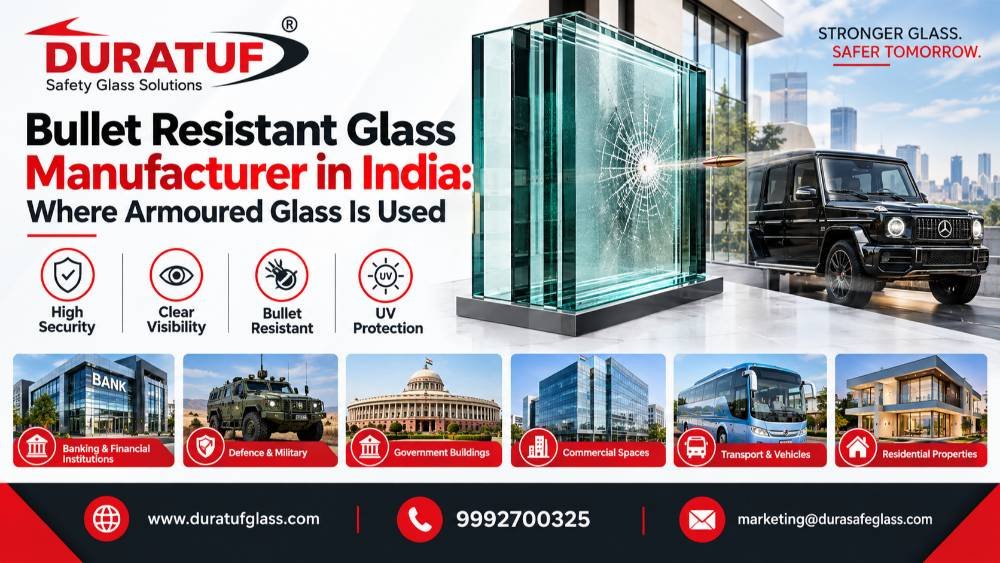
Quick answer: A bullet resistant glass manufacturer in India supplies armoured glazing for security vehicles, banks, control rooms, jewellers and public counters. The right choice depends on the threat, the frame, the weight limit and how clear the view must be.
Armoured glass used to be a niche product. Today, more organisations ask for it, from cash-handling firms to government departments. If you are researching a bullet resistant glass manufacturer in India for a real project, it helps to see how the glass behaves in each setting, because the needs are not the same.
1. Security and armoured vehicles
Vehicles are the toughest setting. The glass must be strong, but it also has to be light enough for the vehicle, clear enough for the driver, and fitted so doors and windows still work. Paramilitary and high-security vehicles are one of the sectors served by Duratuf Glass.
Key points to plan for:
- Weight and its effect on suspension and door hinges.
- Window mechanisms that can carry heavier glass.
- A spall layer on the inside face to protect occupants.
- Edge sealing that survives vibration and weather.
2. Banks and cash-handling areas
Counter screens, teller booths and cash rooms use bullet resistant glass so staff can serve customers without being exposed. Here, clarity and sound matter. Speech needs to pass through the screen, so installers often add speak-through units.
3. Control rooms and checkpoints
Police posts, ticket offices and monitoring rooms use armoured glazing to protect people who work with the public. A bullet resistant glass manufacturer in India will usually ask whether the glass faces the outside or the public, because it changes the layer order.
4. Jewellery and high-value retail
Shops use ballistic glass at counters and in display windows. In these cases, appearance counts as much as strength, so low-distortion glass is preferred.
5. Embassies, offices and critical sites
Some buildings use armoured glass on the ground floor or at reception. The façade design, frame and anchoring must all match the glass rating.
| Setting | Main concern | What to confirm with the manufacturer |
| Armoured vehicles | Weight, visibility, spall | Build-up, weight per square metre, edge sealing |
| Banks | Clarity, voice transfer | Speak-through options, finish |
| Control rooms | Public-facing protection | Threat level, frame rating |
| Jewellery shops | Appearance and strength | Optical quality, anti-glare options |
| Critical buildings | Façade integration | Structural design and anchoring |
How glass layers are chosen
Most designs mix glass and interlayers, and some include polycarbonate. The order matters. Glass faces the threat side to break up the round, while softer layers sit behind to absorb the energy. This is why you should never copy a build-up from another project without checking the threat level. The idea builds on laminated glass technology, and many projects also use toughened glass as one of the layers.
Questions to ask any supplier
- Which standard was the glass tested to?
- Can I see the certificate for this exact build-up?
- How much does one square metre weigh?
- Is the glass spall-resistant on the safe side?
- What frame and fixing do you recommend?
- What is the delivery lead time for my size?
You can read more about standards on the BIS website and the ISO site.
Good practice after installation
- Keep the glass clean with non-abrasive cleaners.
- Check edges and seals regularly.
- Do not drill or modify glass on site.
- Replace any panel that has taken a hit, even if it looks intact.
Talk to a team that works with security glass
Duratuf Glass has produced glass since 1986. Its bullet-resistant glass page lists the product family, and the solutions page shows other areas it serves. To start a project, use the contact page.
Frequently asked questions
- Who uses bullet resistant glass in India?
Government agencies, banks, cash-handling firms, jewellers, security services and some private offices. - What should a bullet resistant glass manufacturer in India ask me first?
They should ask about the threat level, the location, the size of the glazing and the type of frame. - Can bullet resistant glass be used in car windows?
Yes, but it needs a vehicle-specific design that accounts for weight, window mechanism and visibility. - Is there a difference between bullet resistant and bullet proof?
Yes. “Bullet resistant” is the accurate term because every build has a tested limit. - Does the glass stop sound?
It reduces outside noise, but speech through a counter screen needs a speak-through unit. - Can I fit it myself?
No. Installation should follow the manufacturer’s guidance and use a rated frame. - Is the glass heavy?
Yes, and the weight rises with the protection level. - Can it be tinted or coated?
Often yes, depending on the build. Ask your supplier about options. - How long does it last?
With correct care and sealing it can serve for many years, but damaged panels should be replaced. - How do I request advice?
Contact the team through the contact page with your application and sizes.