
Architectural Glass Manufacturer in India: 2026 Full Guide
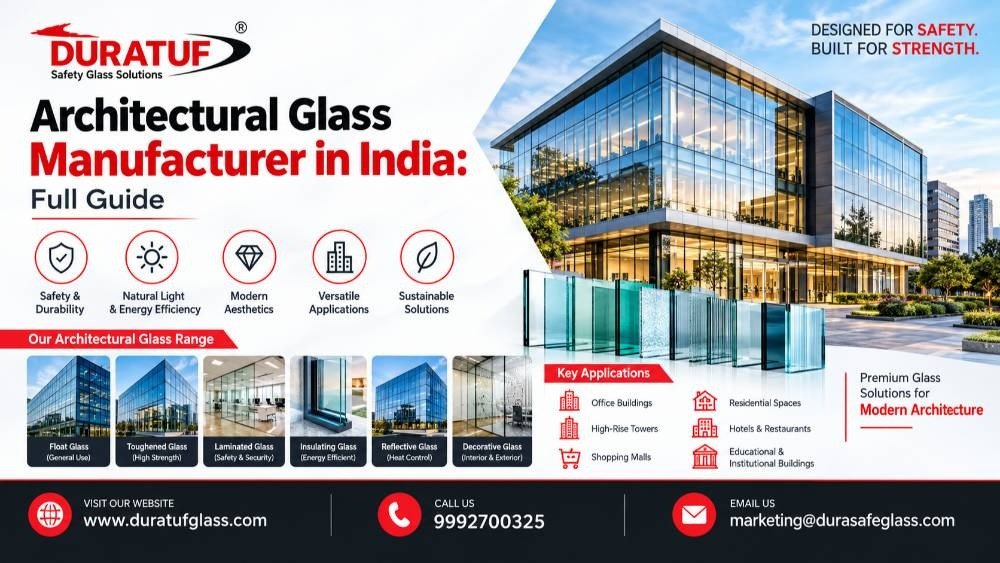
Step inside almost any new office tower, airport terminal or premium residential block built in India over the last few years, and glass is doing far more work than simply letting light in. It is managing heat, cutting noise, meeting fire codes and, increasingly, helping the building earn a green certification. That combination of demands is exactly why finding a capable architectural glass manufacturer in India has become such an important early decision for architects and developers.
This guide covers the main categories of architectural glass used in India, the codes and certifications that shape specification decisions, and what to look for before finalising a manufacturing partner for a facade, skylight or interior glazing package.
What Is Architectural Glass?
Architectural glass refers to processed glass used in the building envelope and interiors — facades, curtain walls, windows, skylights, partitions, balustrades and decorative panels. Unlike basic float glass, architectural glass is almost always further processed through toughening, lamination, coating or insulated-unit assembly to meet safety, thermal or acoustic requirements specific to the building.
| Glass Type | Key Property | Typical Application |
| Toughened (Tempered) Glass | High impact strength, safe breakage pattern | Doors, partitions, balustrades, facades |
| Laminated Glass | Holds together on breakage, blocks UV, reduces noise | Skylights, overhead glazing, ground floors |
| Insulated Glass Units (DGU) | Sealed air/gas gap improves thermal insulation | Curtain walls, cold or extreme-climate facades |
| Low-E Coated Glass | Reflects heat while transmitting daylight | Energy-efficient office and residential facades |
| Reflective / Tinted Glass | Reduces solar glare and heat gain | West-facing elevations, retail frontages |
| Decorative / Back-Painted Glass | Custom colours, patterns and finishes | Interior walls, cladding, feature panels |
Why Demand for Architectural Glazing Is Rising in India
India’s flat glass market — the raw material behind most architectural glazing — was valued at around USD 3.9 billion in 2025 and is projected to reach USD 6.4 billion by 2034, at a compound annual growth rate of roughly 5.55%. A rising number of eco-friendly and green-certified buildings, along with growing use of flat glass in photovoltaic and e-glass structures, is a major part of that growth story.
Green building movements have played a particularly large role in shaping specification. The Indian Green Building Council (IGBC) and similar rating systems have pushed architects to specify higher-performance glazing that supports daylighting and energy targets simultaneously, rather than treating glass as a purely cosmetic choice. As one environmental commentary on facade design has observed, glass has effectively become the “in-thing” across climate zones as different as Bengaluru and Gurgaon, precisely because performance glazing can now be tuned to very different thermal conditions.
Codes That Shape Architectural Glass Specification
The Energy Conservation Building Code (ECBC), developed by the Bureau of Energy Efficiency, sets minimum energy performance standards for commercial buildings with a connected load above 100 kW or a built-up area exceeding 1,000 square metres. ECBC-compliant buildings can achieve energy savings of 25-50%, and the building envelope — glazing included — is one of the primary levers used to hit that target.
Alongside ECBC, the National Building Code (NBC), developed by the Bureau of Indian Standards (BIS), sets revised norms for glass used in buildings, covering general requirements, appropriate thickness determination, human-impact safety criteria, installation practice, fire safety and energy or thermal performance. For safety glass specifically, IS 2553 governs testing and certification, and any architectural glass manufacturer in India worth considering should be able to demonstrate compliance with both codes where applicable.
Choosing the Right Architectural Glass Manufacturer in India
- Processing capability — toughening, lamination, coating and insulated-unit assembly under one roof
- Certification — BIS/IS 2553 compliance and NBC-aligned documentation
- Large-format capacity — facades and curtain walls often need bigger panel sizes than standard stock glass
- Colour and coating consistency — critical for multi-storey facades viewed as a single surface
- Design and technical support — guidance on climate-appropriate glazing selection
- Project references — completed commercial, institutional or residential facades of comparable scale
- Delivery and handling track record — large architectural panels are fragile and require careful logistics
DURATUF: An Established Architectural Glass Manufacturer in India
DURATUF Glass Industries, established in 1992, operates a conglomerate of seven manufacturing units across Delhi, Haryana, Indore and Bangalore, with a product portfolio that spans automotive, security, railway and architectural segments. The company’s architectural offerings draw on the same in-house toughening and lamination expertise developed over more than three decades of automotive and security glass manufacturing, giving it the process control that large facade packages demand.
This cross-segment expertise matters in practice: a manufacturer that already meets IS 2553 for road-transport safety glass and produces bullet-resistant panels for security applications typically brings a stricter internal quality discipline to architectural glazing as well, since the underlying processing standards carry across product lines. To review the full range of architectural and other glass solutions, visit DURATUF’s solutions page, or contact the technical sales team with facade drawings and performance requirements for a detailed quotation.
Sustainability Trends Shaping Architectural Glass
- Solar-control and Low-E coatings are increasingly specified together to cut both glare and cooling load
- Insulated glass units are moving from a premium option to a standard specification in many commercial projects
- Recycled cullet content is gaining attention as manufacturers look to lower furnace emissions
- Smart, switchable glazing is entering premium architectural projects for on-demand privacy and shading
- Daylight-optimised facades are being designed to reduce artificial lighting load without increasing heat gain
Common Specification Mistakes to Avoid
- Applying one glazing specification across facades with very different orientations
- Overlooking acoustic performance in facades facing busy roads or airports
- Underestimating lead times for large-format or custom-coated architectural panels
- Skipping mock-up or sample panel approval before full production begins
- Not confirming IS 2553 or NBC compliance in writing before finalising the order
Frequently Asked Questions (FAQs)
- What is the most commonly used architectural glass in India?
Toughened glass remains the most widely used base product, often combined with lamination or insulated-unit assembly depending on the safety, acoustic or thermal performance required for a specific facade.
- Is Low-E glass worth the additional processing for Indian climates?
In most Indian climate zones, Low-E coatings meaningfully reduce cooling load by reflecting solar heat while still allowing daylight through, which is why they feature heavily in ECBC-compliant commercial buildings.
- Do architectural glass manufacturers in India need BIS certification?
Yes, safety glass used in buildings falls under IS 2553 and related BIS requirements, and a credible architectural glass manufacturer in India should be able to provide current certification and test documentation.
- What is the difference between insulated glass and laminated glass for facades?
Insulated glass uses a sealed air or gas gap between two panes primarily for thermal insulation, while laminated glass uses a bonded interlayer primarily for safety, UV blocking and acoustic performance; many high-performance facades combine both.
- How long does a typical architectural glazing project take to source?
Timelines vary with panel size and coating complexity, but sample approval, certification checks and production scheduling typically take several weeks before installation-ready glass is delivered.
- Can architectural glass be customised for colour and pattern?
Yes, decorative and back-painted glass options allow custom colours, ceramic-printed patterns and textured finishes for feature walls, cladding and interior partitions.
- What green building codes affect architectural glass specification in India?
ECBC sets minimum energy performance standards for qualifying commercial buildings, while IGBC and GRIHA rating systems influence glazing choices further for developers pursuing formal green certification.
- Is architectural glass safe for high-rise balustrades and glass floors?
Laminated glass is specifically recommended for these applications because it holds together if cracked, reducing the risk of a fall-through incident compared with standard annealed glass.
- How do I compare architectural glass manufacturers before finalising a project?
Request project references of similar scale, confirm certification and test reports, review sample panels in person, and clarify lead times and logistics support in writing before signing a supply agreement.
- Can the same manufacturer handle both facade glazing and interior partitions?
Most established architectural glass manufacturers, including those with automotive and security-glass backgrounds like DURATUF, can supply both exterior facade glass and interior decorative or partition glazing from the same production network.
Conclusion
Architectural glass now sits at the centre of how Indian buildings manage energy, safety and daylight, not just how they look. Choosing an established architectural glass manufacturer in India with genuine in-house processing, verifiable BIS certification and a track record across comparable projects makes the difference between a facade that performs for decades and one that becomes a maintenance headache within a few years.
Whether the project is a full curtain wall, a daylight-optimised office facade, or a decorative interior glazing package, working with a manufacturer who understands both the regulatory codes and the climate-specific performance requirements remains the safest route to a facade that meets its brief on day one and continues to perform long after handover.